
Introduction
Ninh Binh was never going to be just another stop in Vietnam for us.
We visited as an overnight excursion from our 12-Night Thailand and Vietnam cruise on Celebrity Solstice, but this trip had a much more personal reason behind it: Ninh Binh is where my father-in-law, Dad Do, was born and grew up. After years of hearing stories about his childhood and the Vietnam he remembered, we finally had the chance to see this part of the country for ourselves.
And what a place to come from.
Ninh Binh is a landscape of dramatic limestone karsts rising out of brilliant green rice fields, winding rivers disappearing between towering cliffs, ancient temples tucked into the countryside, and small villages where life feels far removed from the chaos of Hanoi. Exploring it by boat, bicycle, or simply driving through the countryside gives you a completely different view of northern Vietnam.
For us, though, the scenery was only part of the experience. There was something incredibly special about traveling through the place where Dad Do’s story began—seeing the landscape he knew as a child and connecting another piece of our family history to a real place on the map.
This guide covers what we saw, what we loved, and what you should know if you’re planning your own trip to Ninh Binh—including how to get there, where to stay, the best things to do, and how much time you really need.
Ninh Binh at a Glance
Where: Northern Vietnam, about 90 km (55 miles) south of Hanoi
Known for: Towering limestone karsts, rice paddies, peaceful rivers, caves, temples, and some of the most beautiful countryside in Vietnam
Best for: Nature, scenery, photography, history, cycling, boat rides, and travelers looking for a quieter contrast to Hanoi
How long to stay: 2–3 days is ideal. Ninh Binh can be visited as a day trip from Hanoi, but staying overnight gives you time to slow down and experience the area after many of the day-trippers leave.
Getting there: Roughly 1.5–2 hours from Hanoi by car, bus, or train. Ninh Binh is also an easy addition before or after a Ha Long Bay cruise. Read my Hanoi travel guide here.
Where to base yourself: Tam Coc is the most convenient choice for most visitors, with restaurants, hotels, bike rentals, and easy access to many of the area’s major sights. Staying in the countryside around Trang An is another great option if you want something quieter and more scenic.
Don’t miss: A sampan boat ride through Trang An or Tam Coc, the climb to the Hang Mua viewpoint, Bich Dong Pagoda, and simply exploring the countryside by bicycle.
What makes it special: Ninh Binh has the kind of scenery that makes you stop whatever conversation you’re having and stare out the window. Limestone mountains rise almost vertically from rice fields and rivers, while boats slip through caves and between cliffs. It feels worlds away from Hanoi even though it’s only a couple of hours south.
Jennifer’s Tip: Don’t squeeze Ninh Binh into a rushed Hanoi day trip if your itinerary allows more time. Spend at least one night. Early mornings and evenings are quieter, cooler, and give you a chance to experience the countryside without the biggest tour groups.
-

- Driving in to Ninh Binh
-

- Tam Coc
-

- At the Base of Hang Mua
Why Visit Ninh Binh?
For us, the reason to visit Ninh Binh was personal—this is where Dad Do was born and grew up. But even without a family connection, Ninh Binh is one of those places in Vietnam that deserves more than a quick glance.
The scenery is spectacular. Huge limestone karsts rise straight out of green rice fields, rivers wind between the mountains, and temples and pagodas appear in seemingly impossible locations. It’s peaceful, dramatic, and completely different from the energy of Hanoi.
One of the best ways to experience Ninh Binh is from the water. We did the boat ride at Tam Coc, and it was amazing. Small sampan boats glide along the Ngo Dong River, surrounded by rice fields and enormous limestone cliffs, before passing right through caves beneath the mountains. One of the coolest parts is watching the local rowers propel the boats with their feet—a traditional rowing technique that leaves their hands free and somehow looks completely effortless.
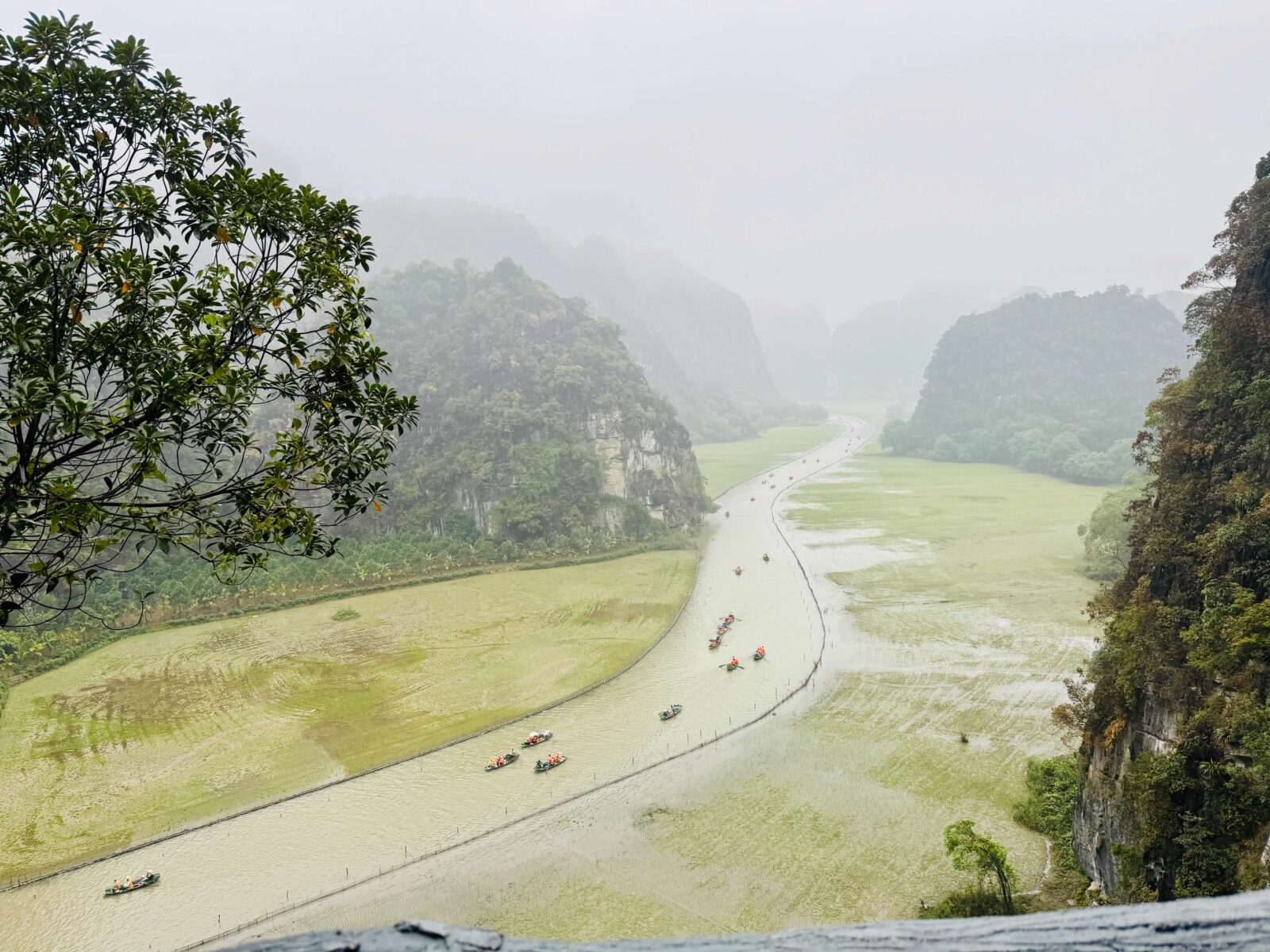
If you’d rather get above the landscape, Ninh Binh also has some fantastic hiking and viewpoints. The climb to Hang Mua is steep—and involves a whole lot of stairs—but the view over the river, rice fields, and surrounding karsts is one of the most iconic in northern Vietnam. Be aware that you are not guaranteed spectacular views- when we climbed Hang Mua, we could not see a thing! It was still pretty cool, and the mist added an air of mystery to the stunning landscape.
There’s plenty of history and culture, too. Ninh Binh was home to Hoa Lu, Vietnam’s ancient capital in the 10th and 11th centuries, and the province is dotted with temples, pagodas, caves, and historic sites.
I should also mention that Ninh Binh is no longer an undiscovered corner of Vietnam. It has gotten touristy, and Tam Coc in particular has developed a definite backpacker-town vibe, with hostels, bars, restaurants, tour agencies, and plenty of other travelers. If you’re expecting an untouched rural village, this isn’t it.
But don’t let that put you off. Once you’re out on the river, climbing into the mountains, cycling through the rice fields, or exploring the countryside beyond the main tourist strip, it’s easy to understand why so many people come here in the first place. Ninh Binh is still amazing.
Come for the scenery, but give yourself enough time to get out on the water, climb something, explore the countryside, and experience Ninh Binh from more than one angle.
Where to Stay in Ninh Binh
Ninh Binh is a province in northern Vietnam, about two hours south of Hanoi. Although there is also a city called Ninh Binh, most travelers use “Ninh Binh” to refer to the surrounding countryside and attractions, particularly around Tam Coc and Trang An. Ninh Binh City is the transportation and commercial hub for the province, but Tam Coc is the tourist hub and tourist activities center around it,Trang An, Hang Mua, Hoa Lu, Bich Dong, Bai Dinh, and the surrounding karst-and-rice-field countryside. We stayed in Tam Coc, which is a cool backpacker haven with cute shops, cafes, and massage/nail salons.
Tam Coc: Best for Most First-Time Visitors
Tam Coc is where I would recommend most first-time visitors stay. It puts you right in the middle of the action, with restaurants, cafés, bars, shops, bike rentals, tour operators, and the Tam Coc boat landing all close by. It also makes a convenient base for visiting Bich Dong Pagoda, Hang Mua, Trang An, and the other major sights.
The trade-off is that Tam Coc is firmly on the tourist trail. It has developed a bit of a backpacker-town feel, and the center can be busy. But you don’t have to go very far to find rice fields, limestone mountains, and much quieter surroundings.
We stayed at Tam Coc Serene Bungalow, and I loved it. It was exactly the kind of place that felt right for Ninh Binh—small, relaxed, surrounded by all that gorgeous scenery, and away from the busiest part of Tam Coc while still being convenient to everything we wanted to do. After a day of boat rides, climbing mountains, and exploring, it was lovely to come back to somewhere that felt peaceful and personal rather than like a big hotel. And the breakfast spread was unusual but impressive.
Would I stay there again? Absolutely. There are plenty of newer and fancier places in Ninh Binh, but I have very fond memories of our little bungalow in Tam Coc—and sometimes that matters more to me than another five-star hotel.
Trang An: Best for Scenery and Quiet
If your priority is waking up surrounded by karsts, rice fields, and countryside rather than being able to walk to a bunch of restaurants, look around Trang An.
This area tends to feel quieter and more spread out than central Tam Coc, with scenic homestays, bungalows, and resorts tucked among the limestone mountains. You’ll sacrifice some walkability, but that may be exactly what you want.
Ninh Binh City: Best for Transportation and Local Life
Ninh Binh city has the train station, local restaurants, shops, and plenty of hotels, but it isn’t where I would base myself purely for sightseeing. Most of the places you’ve traveled all this way to see are outside the city.
That said, staying here can make sense if you’re arriving late by train, leaving early the next morning, or simply want to experience a less tourist-oriented side of Ninh Binh.
Countryside Homestays: Best for Getting Away From It All
You’ll also find small hotels, homestays, and bungalows scattered throughout the countryside between the major attractions. These can be fantastic if your vision of Ninh Binh involves waking up to limestone peaks and rice paddies rather than stepping outside into a tourist hub.
Just pay attention to the location before booking. That gorgeous secluded bungalow may also mean you need a bicycle, scooter, Grab, taxi, or private driver every time you want to go somewhere.
Jennifer’s Tip: For a first visit, I’d choose Tam Coc, but I wouldn’t necessarily stay right in the busiest part of the center. Look for somewhere on the edges of Tam Coc where you can have the restaurants and conveniences nearby while still getting the rice fields, karsts, and peaceful scenery that make Ninh Binh so special.
The Best Things to do in Ninh Binh
Why Does Ninh Binh Look Like This?
Ninh Binh’s extraordinary landscape is the result of millions of years of water working its way through limestone. Rain and groundwater gradually dissolved the rock, creating caves, narrow valleys, underground passages, and the towering limestone karsts that dominate the landscape today. Rivers and waterways wind between the cliffs—and sometimes right through them—creating the maze of mountains, caves, and water that makes boat trips at Tam Coc and Trang An so spectacular. In fact, Tam Coc means “three caves,” named for the three natural caves the Ngô Đồng River passes through.
Go for a Boat Ride
Tam Coc or Trang An: Which Boat Ride Should You Choose?
Two of Ninh Binh’s most famous experiences involve getting into a small sampan and letting someone row you through an almost ridiculously beautiful landscape. Tam Coc and Trang An are similar, but they aren’t the same experience.
We actually planned to do Trang An. Apparently, so did everyone else in Ninh Binh.
When we arrived, the line was ridiculous and we were told to expect about a two-hour wait. We had limited time and absolutely no desire to spend two hours of it standing in line, so we changed plans and headed to Tam Coc instead.
It turned out to be a very happy Plan B.
Tam Coc follows the Ngô Đồng River through a broad, open landscape of towering limestone karsts and rice fields. The boat passes through three natural caves carved beneath the mountains—Tam Coc actually means “three caves.”One of the things that makes the ride particularly memorable is watching the local rowers propel the boats with their feet, a traditional technique that somehow looks much easier than I’m sure it actually is.
Tam Coc is especially beautiful when the rice fields along the river are green or golden, but even when we visited in mistier conditions, the scenery was incredible. The mist hung between the limestone peaks, giving the landscape an almost otherworldly feel.
Trang An is the larger and more elaborate boat experience. Rather than following one river out and back, Trang An offers several routes through a network of waterways, caves, limestone valleys, and temple stops. You pass through more caves than you do at Tam Coc, and some routes include stops where you get out of the boat to explore temples and historic sites. Trang An is also part of the UNESCO-listed Trang An Landscape Complex.
So which should you choose?
Choose Tam Coc if you want the classic river-and-rice-field scenery, the famous foot-rowers, and a somewhat simpler boat trip that leaves plenty of time for other activities that day.
Choose Trang An if you want a longer, more immersive journey through caves and karst valleys, with temples and stops along the way. It tends to feel more like an excursion in its own right rather than simply a boat ride.
If you have enough time, there’s no reason you can’t do both—but I wouldn’t sacrifice another Ninh Binh experience just to check off two similar boat trips.
*Jennifer’s Tip*: Have a Plan B. We went to Trang An intending to take the boat ride, saw the enormous line, heard “two hours,” and promptly reconsidered our life choices. Tam Coc was our backup, and it ended up being one of our favorite experiences in Ninh Binh. Sometimes changing the plan works out beautifully.
See Bich Dong Pagoda
We didn’t make it to Bich Dong Pagoda, but this is one I really wish we had squeezed in. I guess we’ll have to go back! Just a couple of kilometers from Tam Coc, this centuries-old temple complex climbs straight up—and into—a limestone mountain.
Three pagodas sit at different levels of the karst, connected by stone steps. Along the way, you’ll climb through a natural cave before eventually reaching the Upper Pagoda and views across the surrounding rice fields and limestone peaks. Even the entrance is ridiculously photogenic, with an old stone bridge crossing a lotus pond beneath the mountain.
Its name, Bich Dong, means “Green Pearl Cave,” which seems pretty appropriate.
Jennifer’s Tip: If you’re staying in Tam Coc, this is an easy one to add. Rent a bike, rid
e through the countryside, explore the pagodas, and pair it with the Tam Coc boat ride for a great half-day.
Climb a Karst
If looking up at all those limestone karsts isn’t enough, climb one.
Hang Mua (Mua Cave) is Ninh Binh’s most famous viewpoint, reached by climbing roughly 500 stone steps up the side of a limestone mountain. And let me tell you: those 500 steps are no joke. The climb is steep, uneven in places, and pretty brutal.
We did it on a cloudy, rainy day, which meant we didn’t get those famous sweeping views over the Ngô Đồng River and rice fields that you see in all the photos. Instead, the surrounding karsts appeared and disappeared into the clouds and mist.
And somehow, that seemed appropriate.
The mist gave the mountains an air of mystery and made the whole landscape feel ancient and almost otherworldly. Would I have liked to see the spectacular view from the top? Of course. But I also wouldn’t trade the
moody, mist-shrouded Ninh Binh we experienced.
At the summit, you’ll find the famous stone dragon winding along the ridge, along with a small pagoda and several viewpoints. Just remember that after congratulating yourself for surviving 500 steps up, you still have to get back down.
*Jennifer’s Tip*: Wear shoes with good traction, bring water, and don’t underestimate this climb. The stone steps can be slippery when they’re wet—we know this from experience—and the combination of steep stairs, humidity, and rain makes 500 steps feel like considerably more. But even without the postcard-perfect view, I’d absolutely do it again.
Hoa Lu Ancient Capital — Not to Be Confused With the “Ancient Town”
Here is something we didn’t figure out until later: Hoa Lu Ancient Capital (Cố đô Hoa Lư) Hoa Lu Ancient Town (Phố Cổ Hoa Lư) are not the same place.
Oops
We visited the very pretty Hoa Lu Ancient Town, with its lanterns, shops, crowds, glowing golden pagoda, and romantic little boat rides. We had a great time—but it is a modern tourist attraction inspired by traditional Vietnamese architecture.
Hoa Lu Ancient Capital, on the other hand, is the real deal.
Hoa Lu became the capital of Vietnam in 968 and remained the country’s political center until the capital moved to Thang Long—today’s Hanoi—in 1010. Surrounded by towering limestone mountains, its location provided natural protection for the early Vietnamese kingdom.
Don’t expect a preserved ancient city with streets and palaces still standing. Much of the original capital is gone, but you can explore historic temples dedicated to the Dinh and Le emperors, old gates, courtyards, and archaeological remains, all surrounded by Ninh Binh’s dramatic karst landscape.
We didn’t visit because we genuinely thought we’d already been there. Ancient Town. Ancient Capital. Hoa Lu. We apparently needed a flowchart.
If you’re interested in Vietnamese history, don’t make our mistake—put Hoa Lu Ancient Capital into your map and make sure that’s where you’re actually going. With that said, we actually loved the Ancient Village!
*Jennifer’s Tip*: You can easily combine Hoa Lu Ancient Capital with Trang An and Hang Mua since they’re all in the same general area. And double-check the name before you get in the car. Trust me on this one.
-

- Tam Coc
-

- Tam Coc
-

- Ancient Village
-

- At the Base of Hang Mua
-

- Hang Mua Area
-

- From the Peak of Hang Mua
Visit the “Ancient Village”
Hoa Lu Ancient Town was one of those unexpected places that we absolutely loved. After dark, the whole area glowed with lanterns and golden lights reflecting off the water, with the illuminated pagoda rising above it all. Little boats drifted across the water beneath the lights, and despite the enormous crowds, the whole scene somehow still felt atmospheric and romantic.
And yes, it was crowded. Thousands-of-people crowded. But strangely, that was part of what made it so much fun. The majority of the visitors around us were Asian, and rather than feeling like we’d stumbled into an attraction created solely for Western tourists, it felt more like being swept up in a huge evening festival. We wandered with the throngs of people, watched the boats, explored the shops and food stalls, and simply soaked up the energy.
One of my favorite details was the landscape itself. Even here, right in the middle of all the lights and activity, Ninh Binh’s limestone karsts towered overhead, with beautiful old trees somehow growing right out of the rock. It was such a distinctly Ninh Binh combination—mountains, water, lanterns, temples, crowds, and a little bit of magic.
Is Hoa Lu Ancient Town actually ancient? No. It’s a modern cultural and entertainment complex inspired by traditional Vietnamese architecture. But don’t let that make you dismiss it. We thought it was gorgeous, festive, romantic, and an unexpectedly memorable part of our time in Ninh Binh.
Go after dark. This is one place where the lights, the crowds, and the energy are the experience.


-

- SflyProxyVersion 1;
What to Eat in Ninh Binh
Try Ninh Binh’s Famous Mountain Goat
If there is one local specialty you should try in Ninh Binh, it’s mountain goat, or dê núi. Goat is a big deal here, and you’ll find restaurants serving it just about every way imaginable—grilled, steamed, stir-fried, tossed with lime and herbs, and simmered in hot pots.
For us, though, eating goat in Ninh Binh was about much more than checking off a local specialty. Dad Do remembered going out with his buddies for goat and beer when he was young, so naturally we had to recreate the experience.
We ended up at a two-story goat restaurant on the outskirts of town that felt about as local as we could possibly get. I was the only Westerner in the place. We ordered several different goat dishes to share, surrounded by tables of Vietnamese families and groups of friends doing essentially what Dad Do remembered doing decades earlier.
It was warm. The beer was warm. And it was perfect.
This wasn’t a polished tourist restaurant in Tam Coc, and that was exactly the point. Sitting there eating goat and drinking beer in the place where Dad Do had grown up felt like we were getting a tiny glimpse into his Ninh Binh—not just visiting the Ninh Binh that exists for travelers today.
If you want to try it yourself, look for a restaurant specializing in dê núi rather than limiting yourself to the tourist restaurants around Tam Coc. Order a few different preparations for the table (we tried 5, including tartare which I do not recommend), add some cơm cháy (Ninh Binh’s famous crispy rice), grab a beer—and don’t worry too much if the beer isn’t cold.
-

- Dê Chính Thư 2
-

- Goat 4 Ways
-

- The Fam Enjoying Goat
What Else Should You Eat in Ninh Binh?
Goat may get most of the attention, but it’s definitely not the only local specialty worth trying. If you have a couple of days in Ninh Binh, keep an eye out for these:
Cơm Cháy – Crispy Rice
This is probably Ninh Binh’s other most famous food, and it is pretty tame. Cơm cháy is crispy, golden rice crust that is broken into pieces and served crunchy, sometimes topped with savory ingredients or alongside a rich sauce for dipping. You’ll see it everywhere, and it pairs particularly well with—you guessed it—goat.
Miến Lươn – Eel Vermicelli
If you want to venture beyond the standard tourist checklist, look for miến lươn. This local noodle dish combines thin glass noodles with freshwater eel, herbs, and a deeply savory broth. It may not photograph as dramatically as Ninh Binh’s limestone mountains, but this is exactly the sort of regional dish I look for when I travel.
Ốc Núi – Mountain Snails
Ninh Binh’s limestone mountains are home to mountain snails, which are considered a local delicacy. They’re typically prepared simply with ingredients like lemongrass, ginger, chile, and lime leaves so the flavor of the snails still comes through. If you’re a snail person, this is one to seek out. I. Am. Not. Unless they are escargots swimming in butter.
Nem Dê – Fermented Goat
Okay, technically I’m sneaking goat back onto the list—but this is different enough to deserve a mention. Nem dê combines goat meat and skin with toasted rice powder and seasonings, then wraps the mixture with aromatic leaves and allows it to ferment. It’s a much more adventurous way to experience Ninh Binh’s most famous meat.
Xôi Trứng Kiến – Sticky Rice with Ant Eggs
And then there are ant eggs.
This specialty from the Nho Quan area combines sticky rice with ant eggs collected from the surrounding mountains. It’s definitely not something you’ll find on every tourist menu, but if your travel philosophy includes “I may only have one chance to eat this,” here you go
I’ve actually eaten ants and ant eggs in Cambodia, so this one doesn’t scare me. They tasted lemony and had a little pop. If anything, I’d be curious to try Ninh Binh’s version and compare- this trip, I did not. Once you’ve eaten ants on vacation, apparently you become the person who has opinions about regional ant cuisine.
*Jennifer’s Tip*: You don’t need to hunt down every specialty on this list. But do venture beyond the restaurants catering exclusively to tourists. Some of our favorite food experiences in Vietnam have happened when we’ve walked into a busy local restaurant, ordered what everyone else seemed to be eating, and figured out the details later.
How to Get Around in Ninh Binh
On Foot
Tam Coc itself is very walkable, with restaurants, cafés, bars, shops, and accommodations clustered around the center. Walking is perfect for exploring town, going out for dinner, or wandering around in the evening, but it isn’t a practical way to see the wider Ninh Binh area.
Ninh Binh’s major attractions are relatively close together, but they’re not all within walking distance. Tam Coc, Trang An, Hang Mua, Hoa Lu, Bich Dong Pagoda, and the other sights are scattered around the countryside, so you’ll need some form of transportation if you want to see more than your immediate surroundings.
Bicycle
If you’re staying around Tam Coc or Trang An, a bicycle is one of the best—and most enjoyable—ways to explore. Much of the countryside is relatively flat, and you can pedal past rice fields, limestone karsts, villages, temples, and water buffalo. Many hotels and homestays rent bikes or provide them for guests.
I wouldn’t rely on a bicycle for your entire Ninh Binh itinerary, though. Some attractions are far enough apart that those leisurely rides through the rice paddies can turn into considerably more exercise than you planned.
Motorbike or Scooter
For independent travelers who are comfortable riding, a motorbike gives you much more freedom. You can easily move between the major sights and stop whenever something along the way catches your eye. Rentals are widely available around Ninh Binh and Tam Coc.
Only do this if you’re genuinely comfortable riding in Vietnam. Vacation is probably not the time to teach yourself how to operate a scooter.
Grab
Yes, you can use Grab in Ninh Binh. It can be a convenient way to arrange rides without negotiating taxi fares, particularly around Ninh Binh city and the main tourist areas such as Tam Coc.
Just don’t expect Hanoi-level availability everywhere. Once you get farther into the countryside—or later in the evening—finding a ride may be less reliable. If you’re planning a full day of sightseeing, hiring a driver may be easier than hoping there will be a Grab waiting at every stop.
Taxi or Private Driver
Taxis are another easy option, especially if you have limited time, don’t want to ride a scooter, or are traveling with several people. Your hotel can usually arrange one for you.
If you’re visiting several attractions in one day, consider hiring a private car and driver for the day. You’ll have transportation waiting for you at each stop and won’t have to worry about finding another ride from a temple or trailhead somewhere out in the countryside.
By Boat
And then there is my favorite form of Ninh Binh transportation: the kind where someone else does all the work.
The famous boat trips at Tam Coc and Trang An aren’t really transportation from one attraction to another—they’re attractions in themselves. We did the Tam Coc boat ride, where the local rowers somehow propel their boats with their feet while you sit back and watch limestone cliffs, rice fields, and caves drift past. It remains one of my favorite memories of Ninh Binh.
A Simple Route-Planning Example
If you’re staying in Tam Coc, spend one morning doing the Tam Coc boat ride, then bicycle or take a short ride to Bich Dong Pagoda. On another day, use a scooter or hire a driver to visit Trang An and Hoa Lu, adding Hang Mua for the climb and those spectacular views over the surrounding karsts and rice fields.
Grouping nearby sights together keeps you from wasting your day zigzagging across the province—and gives you more time to actually enjoy it.
*Jennifer’s Tip*: Don’t feel like you have to choose one way of getting around. Use a car, Grab, taxi, or scooter for longer distances, then slow things down with a bicycle or boat once you reach the countryside. In Ninh Binh, getting from Point A to Point B can be part of the experience.
How Many Days do you Need in Ninh Binh?
Technically, you can visit Ninh Binh as a day trip from Hanoi. But you know how I feel about trying to experience a place in a few rushed hours.
I think anywhere worth visiting deserves at least two days—and more is almost always better.
For Ninh Binh, I’d recommend at least two days and two nights. That gives you enough time for a Tam Coc or Trang An boat ride, the climb up Hang Mua, a temple or two, and some time to wander or bicycle through the countryside without turning the entire visit into a race.
If you can spare three days, even better. Add Hoa Lu Ancient Capital, Bich Dong Pagoda, another bike ride, a pedicure, or simply leave yourself enough unscheduled time to follow something interesting when you see it.
Ninh Binh is particularly good for slow travel. Part of its appeal is the scenery between the attractions—the rice fields, little roads winding beneath the karsts, villages, rivers, and places you hadn’t planned to stop.
Could you see the highlights in one very long day from Hanoi? Sure.
But seeing the highlights and experiencing a place aren’t quite the same thing.
*Jennifer’s Tip*: Give Ninh Binh two days minimum; three if you can. And if you have even longer, I certainly won’t be the person telling you to leave.
Best Day Trips and Where to go Next
One of the nice things about Ninh Binh is that it fits easily into a larger northern Vietnam itinerary. You can follow the classic tourist route—or use it as your jumping-off point for somewhere a little less traveled.
Ha Long Bay or Lan Ha Bay: The Classic Choice
You saw Ha Long Bay on land, why not see the actual Ha Long Bay? Ha Long Bay is about 3½–4½ hours away by road, and you can travel directly between Ha Long and Ninh Binh without returning to Hanoi.
In fact, that’s exactly what we did, only in reverse. Our cruise ship ported in Ha Long Bay, and we drove from there to Ninh Binh.
Vuong and I had also visited Ha Long Bay in 2017, when we spent the night on one of the traditional overnight cruises. The bay itself is extraordinary—thousands of limestone islands rising almost vertically out of the water—and if you’ve never seen it, I absolutely think it’s worth experiencing.
What surprised us this time was how much Ha Long itself had grown since our first visit. In 2017, I remember the bay being the destination and the town feeling more like the place you passed through to get there. It certainly doesn’t feel that way anymore.
If you like the idea of cruising among those spectacular limestone islands but want an alternative to the busiest parts of Ha Long Bay, look at Lan Ha Bay, near Cat Ba Island. You still get that incredible karst scenery, but itineraries can take you away from some of Ha Long’s most heavily traveled routes.
Pu Luong: Get Off the Tourist Trail
If you’ve had enough of Vietnam’s major tourist stops and want to head somewhere quieter, Pu Luong Nature Reserve would be my pick.
A few hours west of Ninh Binh, Pu Luong trades tour buses and busy attractions for mountains, terraced rice fields, waterfalls, hiking trails, traditional villages, and stilt houses. It’s not undiscovered, but it sees nothing like the volume of visitors you’ll encounter in Ninh Binh, Ha Long, or Sapa.
This is where I’d go if I had a few extra days and wanted to slow down, hike, and see a more rural side of northern Vietnam.
Phong Nha: If You’re Heading South
If you’re traveling south through Vietnam, Phong Nha is absolutely worth the detour.
We spent time there in 2023 when Vuong and I did the Son Doong expedition, so this is one I can personally recommend. Phong Nha village itself is cute and has definitely developed a tourist scene, but it still has a relaxed, small-town feel. The real reason to come, though, is what lies beneath all those limestone mountains.
The caves are spectacular.
And you absolutely do not have to be crazy enough to trek to Son Doong to enjoy them.
Phong Nha has cave experiences at practically every level of adventure. You can take a relatively easy walk along developed paths and boardwalks through enormous caverns such as Paradise Cave, or take a boat into Phong Nha Cave. You can kayak, swim, zipline, or paddle through other cave systems. And if you want something more adventurous, there are guided treks ranging from challenging day trips to multi-day expeditions involving jungle hiking, river crossings, swimming, climbing, camping, and some seriously wild caves.
And then there’s Son Doong, the world’s largest cave.
That’s what brought us here. Our expedition involved days of trekking through the jungle and caves, river crossings, scrambling and camping underground. It remains one of the most extraordinary adventures we’ve ever done—but you don’t need to go anywhere near that extreme to understand why Phong Nha is special.
That’s what I love about this area: you get to choose your own level of crazy. Take a nice walk through a cave. Paddle a kayak into one. Spend a day trekking. Or disappear into the jungle for several days and sleep underground.
If you’re continuing south from Ninh Binh, Phong Nha also makes a natural stop before heading onward toward Hue, Da Nang, and Hoi An.
So Where Would I Go?
If you’ve never seen Ha Long Bay, go there. It’s famous for a reason, and Ninh Binh and Ha Long make an easy pairing.
If you’ve already done Ha Long—or you’re ready to get away from the major tourist trail—I’d head for Pu Luong.
And if you’re traveling the length of Vietnam, don’t treat Phong Nha as merely a stop on the way south. Give it a few days. The village is charming, the landscape is beautiful, and the caves are unlike anything else you’ll see in Vietnam.
There isn’t really a wrong answer. The bigger mistake, in my opinion, is racing from one famous Vietnamese destination to another without leaving yourself enough time to see what lies between them.
Jennifer’s Tip: Don’t automatically return to Hanoi just because that’s how many packaged itineraries are organized. Look at the map first. Ninh Binh can be a great stepping-off point for your next adventure, whether that’s cruising Ha Long Bay, hiking through Pu Luong, exploring the caves of Phong Nha, or simply following the road to somewhere you hadn’t planned to visit.



0 Comments