
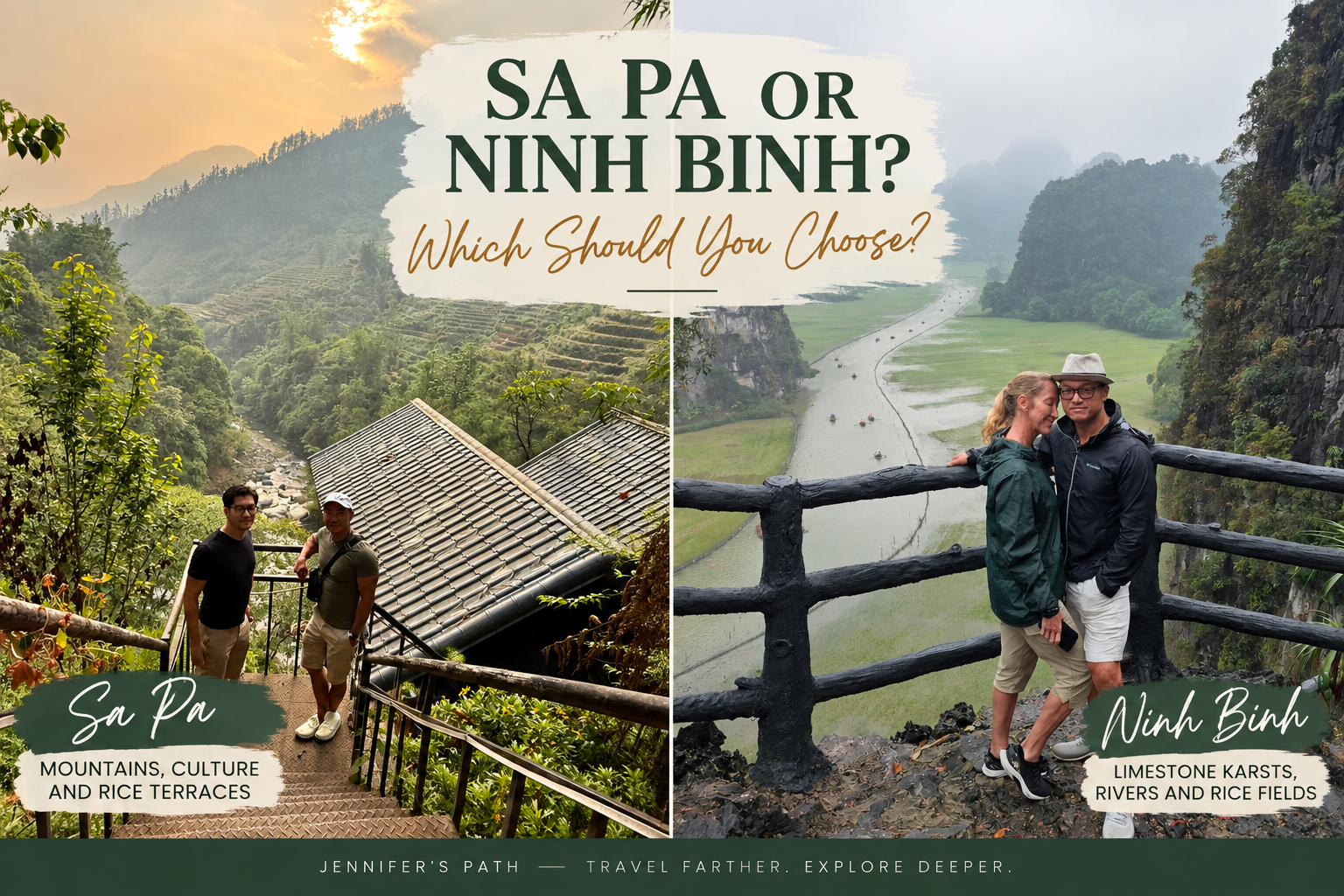
Sa Pa or Ninh Binh?
If you have a few extra days in Hanoi and want to get out of the city, there’s a good chance you’ll find yourself trying to choose between these two very different destinations.
You start researching.
Sa Pa or Ninh Binh?
It’s a question that comes up over and over when planning a trip to northern Vietnam, and I understand why. Both offer spectacular scenery, outdoor adventures, and a completely different experience from Hanoi. Both are easy enough to add to a northern Vietnam itinerary. And both are absolutely worth visiting.
But here’s the problem:
Sa Pa and Ninh Binh are nothing alike.
Sa Pa takes you north into the mountains, where rice terraces spill down steep hillsides, clouds drift through the valleys, and Hmong and Red Dao communities have lived for generations. You can trek between villages, ride a cable car nearly to the top of Fansipan, or simply sit somewhere with a view and watch the mountains disappear and reappear through the mist.
Ninh Binh is greener, flatter, warmer, and dominated by enormous limestone karsts rising almost vertically from rivers and rice fields. Here, you climb into a little wooden boat and float beneath towering cliffs, ride a bicycle through the countryside, explore temples and Vietnam’s ancient capital, and—if you’re feeling ambitious—climb what feels like approximately four million stairs for one of the best views in the region.
I’ve been to Sa Pa twice, nearly a decade apart, and I’ve also traveled through Ninh Binh, so I’ve experienced both destinations very differently. I’ve watched Sa Pa change dramatically between visits. I’ve stayed right in town and far outside it. I’ve ridden the overnight train, visited Cat Cat Village twice, and gone almost to the top of Fansipan without actually climbing a mountain.
In Ninh Binh, we traveled with my father-in-law, who was born and raised in the area. We rode through the karsts at Tam Coc, climbed high above them in mist and drizzle, explored the ancient capital, and ended up at a wonderfully local restaurant eating one of the region’s specialties—goat—with the only non-locals in the room being us.
So if you’re trying to decide between Sa Pa and Ninh Binh, I’m not going to tell you that one is simply “better.”
The better question is:
What kind of experience do you want?
If you want mountains, trekking, cooler weather, and dramatic rice terraces, you may fall hard for Sa Pa.
If you want limestone karsts, river journeys, cycling, history, and easier logistics from Hanoi, Ninh Binh may be exactly what you’re looking for.
And if you have enough time?
Do both.
Because despite how often they’re compared, they aren’t substitutes for each other at all.
Getting There: Sa Pa vs Ninh Binh
One of the biggest differences between Sa Pa and Ninh Binh has nothing to do with the scenery.
It’s how much effort it takes to get there from Hanoi.
Hanoi to Ninh Binh
Ninh Binh is the much easier side trip from Hanoi.
It’s roughly 70 miles south of Hanoi, and you can usually get there in around two to three hours, depending on how you travel. Trains, buses, shared vans, private drivers, and organized tours all make the trip regularly.
That makes Ninh Binh incredibly easy to work into a shorter Vietnam itinerary.
You can even visit as a day trip from Hanoi, although I wouldn’t recommend doing it that way if you have the time to stay overnight. There is enough to do in Ninh Binh that it deserves more than a few hurried hours between two long drives.
Hanoi to Sa Pa
Sa Pa requires more commitment.
It’s tucked into the mountains of far northern Vietnam near the Chinese border, and getting there generally takes five to six hours by bus or shuttle van from Hanoi.
Then there’s the overnight train.
I’ve done this, and it’s an experience in itself.
The train doesn’t actually go to Sa Pa. It travels overnight from Hanoi to Lao Cai, near the Chinese border, and from there you still have roughly another hour of winding mountain roads before you reach Sa Pa.
The advantage is that you’re traveling while you sleep—or at least theoretically sleeping—rather than using up most of a day sitting in a vehicle.
Why This Matters When You’re Choosing
If you only have a couple of days to spare, don’t underestimate this difference.
Ninh Binh is close enough to Hanoi that you can leave in the morning and still have much of the day ahead of you.
Sa Pa is a destination you need to plan around.
That doesn’t make Sa Pa less worthwhile. It just means I wouldn’t travel all the way there for one rushed night. Once you’ve invested the time getting into the mountains, give yourself enough time to actually enjoy being there.
And this may be the first question I’d ask someone trying to choose between the two:
How much time do you actually have?
If the answer is not much, Ninh Binh becomes very appealing very quickly.
Sa Pa vs Ninh Binh at a Glance
If you’re trying to make a quick decision, here’s how I would compare Sa Pa and Ninh Binh.
| Sa Pa | Ninh Binh | |
|---|---|---|
| From Hanoi | About 5–6 hours by road, or overnight train to Lao Cai + transfer | About 2–3 hours |
| Ideal stay | 2 nights minimum; 3–4 if time allows — for both. | 2 nights minimum; 3–4 if time allows — for both. |
| Scenery | Mountains, valleys, terraced rice fields | Limestone karsts, rivers, rice fields |
| Best outdoor experience | Trekking through the mountains and villages | Boat rides, cycling and climbing viewpoints |
| Difficulty level | Can be very active if you’re trekking | Easy to moderate, depending on what you choose |
| Culture | Hmong, Red Dao and other ethnic minority communities | Vietnamese history, temples, ancient capital and rural life |
| Signature experience | Trekking through the rice terraces | Floating through the karsts at Tam Coc or Trang An |
| Big viewpoint | Fansipan | Hang Mua |
| Getting around | Walking, taxis, scooter, guided trekking | Bicycle, scooter, taxi/private driver |
| Weather | Cooler and much more mountainous; fog is common | Warmer, humid and generally more tropical |
| Food to try | Salmon or sturgeon hotpot, grilled foods, regional specialties | Goat, crispy rice and local Vietnamese dishes |
| Tourism level | Very developed around Sa Pa town and major attractions | Very busy at major sights, quieter once you get away from them |
| Best for | Mountains, trekking, dramatic scenery and cultural experiences | Karsts, boat rides, cycling, history and easier logistics |
| Best with limited time | Requires more travel time | Much easier to add to a short Hanoi stay |
The biggest thing I’d take away from this table is that you’re not really choosing between two versions of the same experience.
Sa Pa feels like a trip into the mountains.
Ninh Binh feels like a trip into the landscape.
In Sa Pa, much of the scenery unfolds in front of you—mountains layered into the distance, rice terraces cascading down the hillsides, villages tucked into valleys, and clouds moving through the peaks.
In Ninh Binh, the scenery seems to rise up around you. You’re floating between limestone cliffs in a tiny boat, bicycling beneath enormous karsts, walking through rice fields, or climbing above the landscape to finally see how all those rivers, fields and mountains fit together.
Both are beautiful.
They’re just beautiful in completely different ways.
My Personal Travel Context
Before I start comparing Sa Pa and Ninh Binh, there’s something you should know about my experiences in each place.
I’ve visited Sa Pa twice, almost a decade apart—first in 2017 and again in 2026. That gave me an interesting perspective because I didn’t just see Sa Pa twice; I saw how much it had changed between those visits.
On our first trip, we stayed at the Victoria Sapa Resort and spent time exploring the town and surrounding area, including Cat Cat Village. When we returned in 2026, we visited Cat Cat again, rode the cable car up Fansipan, and stayed farther outside the center—which also taught me that next time, unless I’m specifically going to Sa Pa for a trekking or homestay experience, I’d rather stay closer to town.
Ninh Binh was a completely different kind of trip.
We traveled there with my father-in-law, Dad Do, who was born and raised in Ninh Binh. While I was experiencing the area for the first time, we were traveling with someone who had once called it home.
We took a boat through Tam Coc, explored the ancient capital, climbed high above the karsts in cloudy, drizzly weather, and ended up at a wonderfully local restaurant eating goat, one of Ninh Binh’s specialties. We were the only non-locals in the restaurant, while Dad Do was happily revisiting memories of eating goat and drinking beer with friends when he was younger.
So these aren’t two destinations I experienced under identical circumstances.
Sa Pa is somewhere I’ve returned to and watched change.
Ninh Binh is somewhere I experienced once, but with a family connection that gave the trip an entirely different dimension.
That’s worth keeping in mind as I compare them.
Which Has Better Scenery: Sa Pa or Ninh Binh?
This may be the hardest comparison because the scenery is the reason I’d tell you to visit both.
But they’re beautiful in completely different ways.
Sa Pa: Mountains, Rice Terraces and Big Views
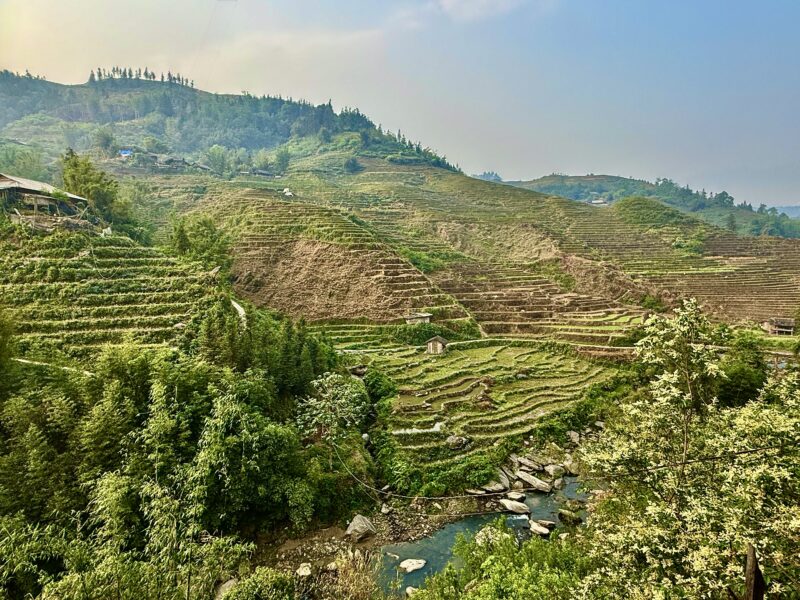
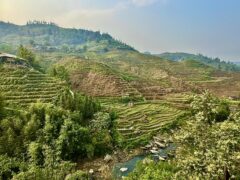
Rice Terraces Near Sa Pa, Vietnam
Sa Pa is all about scale.
The town sits high in the mountains of northern Vietnam, surrounded by deep valleys, terraced rice fields, and peaks that seem to continue forever into the distance.
And the weather is part of the scenery.
I’ve visited Sa Pa twice, almost a decade apart, and both trips included some combination of clouds, mist, mountains appearing and disappearing, and views that changed completely within a matter of hours.
Sometimes you wake up and can see across the entire valley.
Sometimes the clouds roll in and swallow everything.
I actually think that’s part of Sa Pa’s personality.
The rice terraces are another huge part of what makes this area so beautiful, although what they look like depends enormously on the time of year. They may be brilliant green, golden and ready for harvest, freshly planted and reflecting the sky, or relatively bare.
Then there’s Fansipan, the highest mountain in Vietnam.
You don’t have to trek to the summit to experience it. The cable car carries you high into the mountains, and on a clear day the views are spectacular.
Of course, “on a clear day” is doing some work in that sentence.
This is Sa Pa.
The clouds have opinions.
Ninh Binh: Limestone Karsts, Rivers and Rice Fields
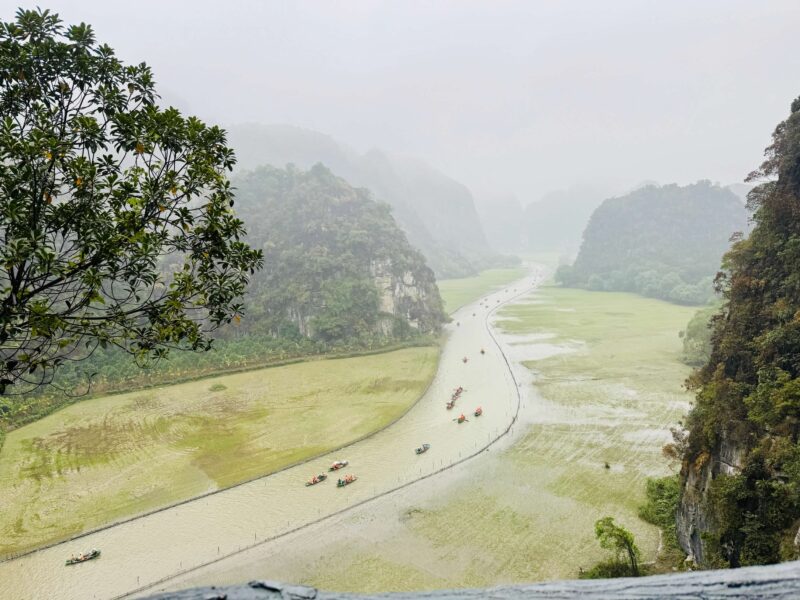
Boats rowing through the landscape in Tam Coc, Ninh Binh
Ninh Binh is dramatic in a completely different way.
Instead of looking across enormous mountain valleys, you find yourself inside the landscape.
Massive limestone karsts rise almost vertically from flat rice fields and winding rivers. Roads curve around their bases. Temples sit beneath them. Boats disappear between them.
And then you climb above them and realize just how extraordinary the whole landscape really is.
One of my favorite experiences in Ninh Binh was our boat ride through Tam Coc. You sit low in a small wooden boat while someone—quite possibly rowing with their feet—takes you along the river between towering limestone formations and through caves.
It’s quiet, slow and completely different from looking at scenery from a viewpoint.
Then we climbed high above the karsts for one of those famous Ninh Binh views.
It was cloudy. It was drizzling.
And the climb was brutal.
But I didn’t mind the weather nearly as much as I expected. The mist wrapped itself around the limestone peaks and gave the entire landscape an almost otherworldly quality.
Would I have liked a brilliant blue sky for the photographs?
Of course.
But the moody weather somehow suited Ninh Binh.
So Which Is More Beautiful?
I genuinely wouldn’t choose one as more beautiful.
But I experienced the scenery differently in each place.
In Sa Pa, I often felt like an observer. I stood on mountainsides, looked across valleys, and watched clouds move through layers of rice terraces and distant peaks. The landscape was enormous and beautiful, but much of the time I was looking at it.
Ninh Binh felt different.
I felt like I was inside the landscape.
We floated between the karsts, rode beneath them, walked among them, and eventually climbed above them. The limestone cliffs weren’t something off in the distance—they were all around us.
That’s probably the simplest way I can explain the difference:
In Sa Pa, I looked out at the landscape.
In Ninh Binh, I traveled through it.
Neither experience is better. They’re simply very different ways of experiencing a beautiful place.
If enormous mountain vistas and rice terraces are what you picture when you dream about northern Vietnam, Sa Pa may be the landscape you’re looking for.
If you’d rather float, ride, walk, and climb your way through the scenery, I’d lean toward Ninh Binh.
Sa Pa vs Ninh Binh for Hiking and Adventure
If your idea of a good vacation involves getting outside and actually doing something, both Sa Pa and Ninh Binh deliver.
But once again, they do it very differently.
Choose Sa Pa for Trekking
If hiking and trekking are a major reason you’re coming to northern Vietnam, Sa Pa has the advantage.
The mountains surrounding Sa Pa are threaded with trails connecting rice terraces, valleys, and villages inhabited by Hmong, Red Dao, and other ethnic minority communities. You can do anything from a relatively easy half-day walk to a full-day hike or a multi-day trek with an overnight homestay.
Interestingly, despite visiting Sa Pa twice, I haven’t actually done a proper Sa Pa trek.
And it’s not because I don’t trek.
I’ve done my fair share of hiking and mountain adventures around the world, from the trails around Machu Picchu in Peru to climbing Jebel Toubkal in Morocco, along with plenty of other hikes that have involved questionable decisions, sore legs, and spectacular views.
I just haven’t trekked Sa Pa.
We’ve walked plenty, explored Cat Cat Village, wandered around the mountains, and gone up Fansipan—but I can’t personally tell you what it’s like to spend a full day trekking between the villages because I haven’t done it.
If I returned specifically for a trekking trip, though, I’d approach Sa Pa differently. I’d choose where I stayed based on the trek rather than automatically staying in town, and I’d probably hire a local guide rather than simply following one of the busiest routes.
And then there’s Fansipan.
At 3,143 meters, Fansipan is the highest mountain in Vietnam, and yes, you can actually trek to the summit.
I did not.
I took the cable car.
No regrets.
I’ve climbed enough mountains to know that sometimes it’s perfectly acceptable to let a cable car do the work.
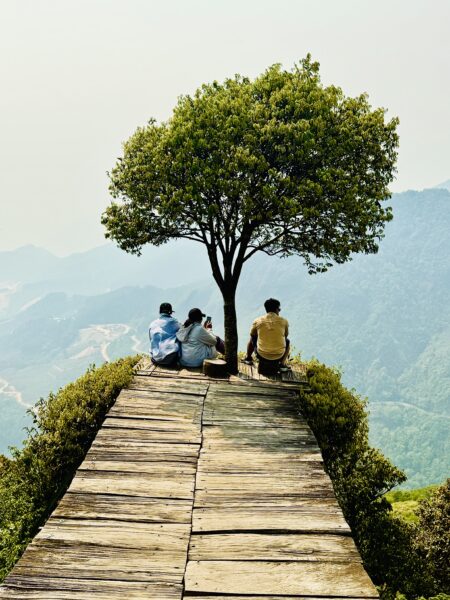
The Lonely Tree, Sa Pa
Choose Ninh Binh for Active Exploring
Ninh Binh isn’t really a trekking destination in the same way.
Instead, the activity is woven into your sightseeing.
You can spend the morning bicycling beneath limestone karsts, climb hundreds of steps for a panoramic view, walk through temples and ancient sites, and then sit down in a little boat and let someone else do the work for a while.
That combination really appealed to me.
Our climb above the karsts was short compared with a proper mountain trek, but don’t confuse short with easy.
There were a lot of stairs.
A LOT of stairs.
It was hot, humid, cloudy, and drizzling—and by the time we reached the top, I was very aware that we had climbed something.
But the view was absolutely worth it.
Cycling is another reason I’d choose Ninh Binh for an active trip. The terrain around Tam Coc is relatively flat, so you don’t have to be a serious cyclist. You can ride through rice fields, beneath limestone cliffs, past little villages and temples, and stop whenever something catches your attention.
For me, that was one of the best ways to experience the area because I didn’t feel like I was traveling from attraction to attraction.
I was simply out in it.
What About the Boat Rides?
I’m counting these as adventure even though you’re mostly sitting down.
At Tam Coc and Trang An, small boats take you along rivers, beneath limestone cliffs, and through caves in the karst.
We chose Tam Coc because the line at Trang An was around two hours when we visited, and I have zero regrets about that decision.
Our rower propelled the boat with her feet, which is something I’d seen in photographs before arriving and still found completely fascinating to watch in person.
It’s not physically demanding for you, obviously.
But floating through caves in a tiny boat beneath enormous limestone cliffs certainly feels more adventurous than sitting on a sightseeing bus.
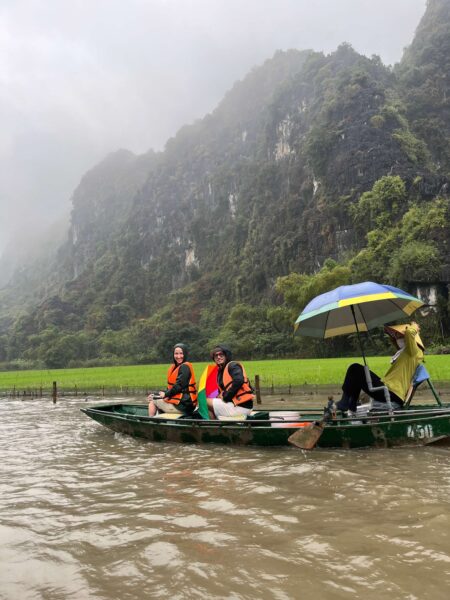
Tac Coc boat ride, Ninh Binh
Which Is Better for Adventure?
This one depends on what you mean by adventure.
If you want to lace up your hiking shoes and spend hours walking through mountains, rice terraces, and villages, Sa Pa offers much more serious trekking.
If you’d rather mix your activity throughout the day—bike for a while, climb something, explore a temple, take a boat through a cave, and then go find lunch—Ninh Binh may suit you better.
That’s probably the distinction I’d use when helping a friend choose:
Sa Pa is where I’d go to trek.
Ninh Binh is where I’d go to play outside.
And if your ideal adventure involves a cable car doing most of the climbing for you?
Sa Pa has you covered there, too.
Sa Pa vs Ninh Binh for Culture and Local Experiences
The cultural experiences in Sa Pa and Ninh Binh are almost as different as the landscapes.
And this is one area where I think it’s important to look beyond the photographs.
Sa Pa: Hmong, Red Dao and Other Ethnic Minority Cultures
One of the things that makes Sa Pa so distinctive is the diversity of the people who live in the surrounding mountains.
The region is home to several ethnic minority groups, including Hmong and Red Dao communities, each with their own traditions, clothing, languages, and customs.
You’ll see this almost immediately.
Women in beautifully embroidered traditional clothing sell handicrafts in town and around popular attractions. Trekking and scooter routes take you through villages and farmland scattered throughout the mountains.
But tourism is also deeply intertwined with all of this.
After visiting Sa Pa twice, almost a decade apart, I noticed just how much the destination itself had changed. There are more hotels, restaurants, organized attractions, and far more infrastructure built around tourism than I remembered from our first visit.
Cat Cat Village, which we visited on both trips, is a perfect example of how complicated the word “authentic” can become.
It’s beautiful. The setting is spectacular. There are traditional buildings, crafts, clothing, performances, waterfalls, and countless places designed specifically for photographs.
On our second visit, my son and nephew even dressed in traditional Hmong clothing for photos.
Was I under the illusion that we’d somehow wandered into an untouched mountain village?
Absolutely not.
Did we have fun?
Absolutely.
And I’m okay with that.
But some of our most memorable experiences in Sa Pa happened when we got farther away from the organized attractions.
One of my favorite ways to explore was by scooter.
The day after our scooter tour, my nephew, niece, and their parents went out on another scooter tour and got even farther into the countryside. At one point, my nephew met a group of Hmong kids and ended up playing soccer with them.
Nobody arranged a “cultural interaction.”
Some kids were playing soccer.
Another kid joined them.
That’s it.
And that’s probably why the story stuck with us.
If I wanted a deeper cultural experience on another trip to Sa Pa, I’d make a point of getting farther into the surrounding countryside again—whether by scooter, trekking with a local guide, or simply leaving enough unscheduled time for something unexpected to happen.
-
- Riding Scooters in the Mountains
-

- Sapa Motorbike Tours
-

- Giant slide near Sa Pa
Ninh Binh: Vietnamese History and Everyday Life
Ninh Binh’s cultural experience is much less about encountering a distinct ethnic minority culture and more about Vietnamese history, religion, food, and rural life.
The region played an important role in Vietnam’s early history. Hoa Lu was the capital of Vietnam in the 10th and 11th centuries, long before Hanoi became the country’s political center.
You can visit temples dedicated to early Vietnamese rulers and walk through a landscape where some of the country’s earliest dynasties established their capital.
But some of my favorite cultural experiences in Ninh Binh weren’t historical attractions at all.
They were much more ordinary.
Traveling with Dad Do, who was born and raised in the area, gave us a connection to Ninh Binh that I couldn’t have created by booking a tour.
One of my favorite memories is eating goat at a local two-story restaurant on the outskirts of town.
Goat is one of Ninh Binh’s regional specialties, and Dad Do remembered eating goat and drinking beer with his friends when he was younger.
So that’s what we did.
The beer was warm.
We were the only non-locals in the restaurant.
And I loved it.
Those are the moments I tend to remember just as much as the famous attractions.
-

- Dê Chính Thư 2
-
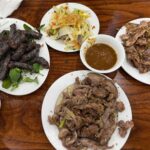
- Goat 4 Ways
-

- The Fam Enjoying Goat
Cat Cat Village vs Ninh Binh’s “Ancient Village”
I think Cat Cat Village in Sa Pa and the “ancient village” we visited in Ninh Binh are perfect examples of why travelers sometimes get a little too obsessed with finding something “authentic.”
Neither fooled me.
And I enjoyed both.
Cat Cat is beautiful, but it’s also unapologetically touristy. There are traditional buildings, waterfalls, performances, shops, costumes, and approximately a million places designed for photographs.
Then in Ninh Binh, we visited what I’ll call the “ancient village.”
There were lanterns everywhere, a glowing gold pagoda, romantic little boats, enormous old trees growing around the karsts, and an almost festival-like atmosphere.
Parts of the setting really were beautiful and atmospheric, but it was also very clearly designed for visitors.
Interestingly, most of those visitors were Vietnamese or other Asian tourists rather than Westerners.
And you know what?
We had fun there too.
-

- Renting traditional Hmong clothing is a popular thing to do in Cat Cat Village, Sa Pa
-

- Hmong ladies selling their wares, Sa Pa
-

- Another example of adventure you can seek out in Sa Pa
-

- Family at the “Ancient Village” in Ninh Binh
-

- The “Ancient Village” in Ninh Binh is charming
-

- Not-so-traditional pagoda at the “Ancient Village” in Ninh Binh
What Does “Authentic” Even Mean?
I don’t think enjoying something touristy makes the experience somehow less legitimate.
Tourism provides jobs and income for local people. You can still learn something about the culture. You can still notice how local families spend their leisure time, try something new, talk to people, eat something you’ve never eaten before, and come away knowing a little more about where you are.
And sometimes the cheesy touristy stuff is simply fun.
That’s allowed.
I also think it’s important to balance those experiences with opportunities to get outside the tourist bubble.
That’s where riding scooters through the countryside, bicycling beneath the karsts, eating at a restaurant where nobody else looks like you, or watching your nephew spontaneously join a group of Hmong kids playing soccer comes in.
Those experiences aren’t necessarily “better” than Cat Cat or the lantern-filled village.
They’re simply different.
And I want room in my travels for both.
For me, the goal isn’t to hunt for some imaginary place where no tourist has ever set foot.
It’s to be curious about where I am, understand what I’m looking at, interact respectfully with the people who live there, spend money in ways that benefit the local community when I can, and leave enough room for the unexpected.
Visit the famous village.
Take the ridiculous photo.
Ride the scooter down the little road.
Eat where the locals are eating.
And if your nephew finds a soccer game?
Stop and let him play.
Which Offers the Better Cultural Experience?
I wouldn’t call one better.
They’re offering completely different things.
Choose Sa Pa if you’re particularly interested in the ethnic minority cultures of northern Vietnam. Visit the popular attractions if they interest you, but also give yourself an opportunity to get beyond them—on foot, by scooter, with a local guide, or simply by leaving enough unscheduled time for something unexpected to happen.
Choose Ninh Binh if you’re more interested in Vietnamese history, temples, regional food, villages, and everyday life in the countryside.
And whichever you choose, don’t spend your entire trip worrying about whether your experience is sufficiently “authentic.”
Be curious. Talk to people. Try the food. Get off the main road occasionally.
And if the cheesy touristy thing looks fun?
Do that too.
Which Is More Touristy: Sa Pa or Ninh Binh?
If you’re hoping I’m going to tell you that one of these places is an undiscovered corner of Vietnam where tourism hasn’t arrived yet, I have bad news.
They’re both touristy.
They’re just touristy in different ways.
We saw backpackers in both places, but the overall traveler vibe was surprisingly different.
Sa Pa Feels More Like a Developed Tourist Destination
Of the two, Sa Pa felt more developed around tourism, particularly in the town itself.
And I’ve had the unusual opportunity to watch that happen.
When we first visited Sa Pa in 2017, it was already a popular destination. When we returned almost a decade later, the amount of development was impossible to miss.
There were more hotels, restaurants, cafés, organized attractions, photo opportunities, and businesses catering specifically to visitors.
The town itself felt busier and more polished—and in some places, considerably more commercial.
Then you have attractions like Cat Cat Village, which make absolutely no attempt to pretend tourists aren’t coming.
We’ve already established that I don’t necessarily consider that a bad thing.
I can enjoy a beautiful mountain view, watch a cultural performance, buy something from a local vendor, take a ridiculous photo, and continue on with my day without having an existential crisis about whether I’m a “real traveler.”
But if you’re picturing Sa Pa as a quiet little mountain town untouched by tourism, you may be surprised.
You need to leave the center to find the quieter version of Sa Pa.
And you don’t necessarily have to trek for three days to do it.
Our scooter rides were one of the easiest ways to get beyond the busiest areas. The farther we rode into the mountains, the more the atmosphere changed. Hotels and souvenir shops gave way to rice terraces, farms, villages, little roads, and ordinary daily life.
That’s the Sa Pa I’d make more time for on another visit.
Ninh Binh Feels More Backpackery—and a Little Bohemian
Ninh Binh gets plenty of visitors too.
Tam Coc, Trang An, and Hang Mua are hardly secrets.
At Trang An, the line for the boat ride was around two hours when we visited. We took one look at it and changed plans.
That’s how we ended up at Tam Coc instead.
And I’m glad we did.
But the overall traveler scene felt different from Sa Pa.
We saw backpackers in both destinations, but Ninh Binh felt more backpackery—and honestly, a little more hippie and bohemian.
There seemed to be more little coffee shops and teahouses, small guesthouses and bungalows, bicycles everywhere, and travelers who looked like they might have arrived for two nights and were considering staying for two weeks.
It had more of a slow-travel feel.
Sa Pa felt like people came with an itinerary: Fansipan, Cat Cat, trekking, viewpoints, next activity.
Ninh Binh felt more like a place where you might ride your bike somewhere in the morning, stop for coffee because a place looked interesting, sit there longer than intended, and eventually decide what to do next.
I liked that about it.
It also felt a little harder to navigate.
That’s somewhat ironic because Ninh Binh is much closer to Hanoi and physically easier to reach. But once we were there, things felt more spread out and less organized around a single walkable tourist center.
That wasn’t necessarily a negative.
In fact, it was part of what I liked about it.
Get on a bicycle and ride for a while.
Turn down a smaller road.
Stop at a coffee or tea shop.
Pass through a village.
Suddenly, the whole experience changes.
Because the attractions are scattered through a larger rural landscape rather than concentrated around one mountain town, I didn’t feel surrounded by tourism all day.
We could visit somewhere popular and then be back among rice fields and karsts a short time later.
Of course, Ninh Binh has its unapologetically touristy side too.
Our lantern-filled “ancient village” was proof of that.
It was atmospheric, photogenic, romantic, a little cheesy, and very obviously designed to attract visitors.
We stayed.
We took pictures.
We enjoyed ourselves.
No regrets.
So Where Will You Notice Tourism More?
For me, Sa Pa felt more commercially touristy, while Ninh Binh felt more backpackery and bohemian.
Sa Pa has a developed tourist center with hotels, restaurants, cafés, shops, and organized attractions all around you.
Ninh Binh has some extremely popular attractions, but everything felt more spread out. Between those busy places, it was surprisingly easy to find ourselves riding through quiet countryside, stopping somewhere for coffee, or simply seeing what was down the next road.
That distinction matters more to me than simply counting tourists.
I don’t need a destination to be undiscovered.
I just don’t want to feel like I’m trapped on a tourism conveyor belt all day.
Both Sa Pa and Ninh Binh let you escape that conveyor belt if you’re willing to move beyond the obvious places.
In Sa Pa, I’d head farther into the mountains.
In Ninh Binh, I’d get on a bicycle and see where it takes me.
Food: Sa Pa vs. Ninh Binh
Food probably isn’t going to be the reason you choose Sa Pa over Ninh Binh—or vice versa.
But you’re going to eat anyway.
And both places have a few things you should absolutely try while you’re there.
What to Eat in Sa Pa
Sa Pa’s food reflects its mountain climate.
One of the things you’ll see everywhere is hotpot, particularly salmon and sturgeon. That surprised me the first time I encountered it in northern Vietnam. Salmon was not exactly the food I associated with Vietnam.
But Sa Pa’s cooler mountain climate supports cold-water fish farming, and both salmon and sturgeon have become local specialties.
We ate at Red Dzao, where salmon and sturgeon were both on the menu, and this is exactly the kind of place where hotpot makes sense.
Sa Pa can be chilly.
It can be rainy.
It can be foggy.
Sometimes it’s all three.
Put a bubbling pot of broth in the middle of the table and suddenly the weather seems like an excellent idea.
You’ll also find plenty of grilled meats and vegetables, often cooked over charcoal, along with dishes influenced by the ethnic minority communities living throughout the mountains.
And because Sa Pa has become such a major tourist destination, there are also plenty of restaurants serving food aimed at international travelers.
You’re not going to have trouble finding something to eat.
What to Eat in Ninh Binh
Ninh Binh has one specialty that you’re going to encounter everywhere:
Goat.
Specifically, mountain goat.
And this was one of those times when having Dad Do with us completely changed the experience.
He grew up in Ninh Binh and remembered going out with his friends to eat goat and drink beer when he was younger.
So naturally, we needed to eat goat.
We ended up at a two-story restaurant outside the main tourist area where we appeared to be the only non-locals in the entire place.
The goat came out.
The beer came out.
The beer was warm.
Apparently refrigeration was not essential to recreating Dad Do’s youth.
And it was one of my favorite meals of the trip.
You’ll see goat prepared several different ways around Ninh Binh, often accompanied by another regional specialty, cơm cháy, crispy rice.
Even if goat isn’t something you’d normally order at home, this is exactly the kind of place where I’d try it.
Which Has Better Food?
I wouldn’t choose either destination based solely on food.
Sa Pa has the cozy mountain-food advantage: hotpot, grilled foods, and meals that seem particularly appealing when the clouds roll in and the temperature drops.
Ninh Binh gave me the more memorable food experience, partly because of Dad Do and the story behind that goat dinner.
And that’s an important distinction.
Sometimes the best meal isn’t the fanciest meal.
It’s the one that connects you to the place you’re sitting in.
Even if the beer is warm.
Where to Stay: Sa Pa vs. Ninh Binh
Where you stay matters in both destinations, but I think it matters even more in Sa Pa.
I learned that one the hard way.
Where to Stay in Sa Pa
I’ve stayed in two very different locations in Sa Pa.
On our first trip, we stayed at the Victoria Sapa Resort, close to the center of town, and I loved the location.
On our second visit, we rented an Airbnb on the outskirts of town.
It wasn’t way out in the mountains. We weren’t surrounded by rice terraces or waking up in some remote Hmong village.
We were basically just far enough outside the center to make us feel like we were missing out on the convenience of being in town—without getting the benefits of actually staying in the countryside.
And our particular Airbnb wasn’t great either, which certainly didn’t help.
That experience changed how I’d choose accommodations in Sa Pa.
If I were returning for a trip focused specifically on trekking, mountain scenery, or a homestay experience, I’d absolutely consider staying well outside town. In that case, being remote is part of the experience.
But if I’m going to stay in Sa Pa itself, I’d stay close to the center.
You’ll have restaurants, cafés, shops, and the general energy of town right outside your door. You can walk around in the evening, find somewhere for dinner without arranging transportation, and still head into the mountains whenever you want.
For me, the outskirts were the worst of both worlds.
Not remote enough to feel immersed in the countryside.
Not central enough to feel like we were part of town.
Where to Stay in Ninh Binh
Here’s something that can be confusing when you’re first planning a trip to Ninh Binh:
Most travelers don’t actually stay in Ninh Binh city.
When people talk about “staying in Ninh Binh,” they’re usually talking about the broader Ninh Binh area—and for most international travelers, Tam Coc is the center of the action.
Ninh Binh city itself is a real, working Vietnamese city and an important transportation hub, but it isn’t where I’d recommend staying for a typical sightseeing trip.
Tam Coc is the traveler hub.
This is where you’ll find the biggest concentration of restaurants, cafés, little bars, tour operators, bicycle and scooter rentals, guesthouses, bungalows, and other travelers. It’s also surrounded by the limestone karsts and rice fields that probably brought you to Ninh Binh in the first place.
There are other options. You can stay closer to Trang An, where you’ll find some beautiful resorts, homestays, and quieter countryside settings. That could be a great choice if you specifically want more seclusion and don’t care about walking into town for dinner.
But for a first visit?
I’d stay in or around Tam Coc.
We stayed at Tam Coc Serene Bungalow, right on the edge of the touristy part of town, and the location was pretty much perfect for us.
One thing you’ll notice when you start searching for accommodations is that there are a lot of little bungalows, homestays, and guesthouses around Tam Coc with remarkably similar names. It can get a little confusing trying to remember which Tam Coc Something Bungalow you were looking at five minutes ago.
Many of them seem to be small, family-run businesses, and travelers have great things to say about all sorts of different ones. I wouldn’t get too hung up on finding the exact place we stayed. I’d pay more attention to location and recent reviews.
Find a well-reviewed little place in a good location, and you’ll probably be just fine.
For us, being right on the edge of the tourist center was ideal. We were close enough that we could easily walk into Tam Coc for dinner, coffee, or whatever else we wanted, but just far enough outside the busiest part that it was quiet when we came back.
And when we wanted to explore farther, we had bicycles.
That gave us exactly the balance I wanted in Ninh Binh: close enough to walk to the action, but far enough away that we didn’t feel like we were sleeping in the middle of it.
It also fit the whole atmosphere of Tam Coc.
Small hotels and bungalows. Coffee shops and teahouses. Bicycles and scooters. Backpackers. That slightly bohemian feel I mentioned earlier.
And then, just beyond all of that, the karsts and countryside.
For me, that’s a much better base for experiencing Ninh Binh than staying in Ninh Binh city itself.
So Where Would I Stay?
In Sa Pa, if you’re planning a typical first visit and want to explore the town as well as the surrounding mountains, I’d stay close to the center.
If you’re specifically coming to trek or want a countryside or homestay experience, then go properly remote and make that part of the trip.
What I wouldn’t do again is split the difference.
In Ninh Binh, I’d base myself in Tam Coc, ideally right around the edge of the main tourist area like we did.
Close enough that you can walk to dinner.
Far enough that it’s quiet.
And ideally somewhere with bicycles so you can get up in the morning and simply start exploring.
*Jennifer’s Tip*: If this is your first trip to Ninh Binh, I’d start by looking for a place in or around Tam Coc. Don’t worry too much about choosing the exact bungalow we stayed in—there are lots of small, well-reviewed places in the area. Location matters more.
For us, staying right on the edge was the sweet spot: quiet at night, walkable when we wanted dinner, and easy to hop on a bicycle and disappear into the karsts during the day.
And I’d use the same logic in Sa Pa. If you want to be part of town, actually stay in town. If you want the mountains, go far enough out that you’re truly getting the mountain experience.
Don’t accidentally choose the awkward middle ground.
How Many Days Do You Need in Sa Pa or Ninh Binh?
If I had plenty of time, I’d give either Sa Pa or Ninh Binh three or four nights.
But let’s be realistic.
Most people aren’t traveling to Vietnam with unlimited vacation time, and both of these places are usually being squeezed into a larger itinerary that also includes Hanoi, Ha Long Bay, and probably several other parts of the country.
So for most travelers, I think two nights is perfectly reasonable.
Would I stay longer?
Absolutely.
How Many Nights in Sa Pa?
I’d happily spend three or four nights in Sa Pa, especially if I wanted to do some serious trekking or spend more time exploring the mountains.
But I would still go for two nights.
Yes, Sa Pa takes longer to reach from Hanoi, but two nights still gives you enough time to get a real taste of the area. You can explore town, visit Cat Cat Village, ride the cable car toward Fansipan, take a scooter ride into the countryside, or fit in a shorter trek.
You won’t do everything.
That’s okay.
The one complication is the weather. Sa Pa’s mountains have a habit of disappearing into the clouds, so the longer you stay, the better your chances of getting one of those spectacular clear views.
If you’re planning a multi-day trek or homestay, that’s different. Give yourself more time.
But for a typical first visit?
Two nights is worth doing. Three or four is better if you have the time.
How Many Nights in Ninh Binh?
I’d say essentially the same thing about Ninh Binh.
Two nights works. Three or four lets you slow down.
Because Ninh Binh is only a few hours from Hanoi, two nights actually gives you quite a bit of usable time. You could take a boat ride at Tam Coc or Trang An, climb Hang Mua, visit Hoa Lu or another historical site, and still have some time to bicycle through the countryside.
What you lose with a shorter stay isn’t necessarily the major sights.
You lose some of the wandering.
And that was one of my favorite things about Ninh Binh.
With an extra night or two, you don’t have to turn every bike ride into transportation between attractions. You can stop for coffee because somewhere looks interesting, take a road because you want to see where it goes, or spend an afternoon doing very little at all.
Ninh Binh rewards that kind of travel.
So What’s the Minimum?
For me, two nights.
I wouldn’t hesitate to visit either Sa Pa or Ninh Binh with two nights available, and for many travelers, that’s probably exactly how much time makes sense.
If you can stretch that to three or four nights, even better.
And if you’re trekking in Sa Pa or simply want to settle into the slower rhythm of Ninh Binh, stay longer.
* Jennifer’s Tip *: Don’t skip Sa Pa just because you only have two nights. Yes, getting there takes longer than Ninh Binh, but I’d still rather have two nights in the mountains than decide it isn’t worth going at all. If you have three or four nights, take them. If you don’t, go anyway.
Weather: When Should You Visit Sa Pa or Ninh Binh?
Weather can make a surprisingly big difference in how you experience both of these places.
But I’m going to say something that may be a little contrary to the usual travel advice:
I almost prefer Sa Pa and Ninh Binh in the mist and fog.
Give me moody mountains over blazing sunshine any day.
Sa Pa: The Clouds Are Part of the Experience
Sa Pa is high in the mountains, so it’s generally cooler than Hanoi and Ninh Binh.
And the weather can change remarkably quickly.
I’ve visited Sa Pa twice, and on both trips there were times when the mountains were completely visible and others when the clouds rolled through and swallowed entire valleys.
I loved it.
There’s something mysterious about watching layers of mountains and rice terraces appear and disappear through the fog. Sa Pa almost seems made for that kind of weather.
Of course, the season also changes what you’re going to see. The famous rice terraces may be brilliant green, golden before harvest, filled with water and reflecting the sky, or relatively bare depending on when you visit.
If seeing the terraces at a particular stage is important to you, timing matters.
But personally, I’m not waiting around for a perfectly clear blue-sky day.
The mist is part of the magic.
Ninh Binh: Mist Looks Pretty Good Here Too
I feel much the same way about Ninh Binh.
The limestone karsts already look slightly otherworldly. Add low clouds and mist curling around them, and the whole place takes on an air of mystery.
We had cloudy, drizzly weather during part of our visit, including our climb above the karsts.
And I loved it.
Would a bright blue sky have made for a different photograph?
Sure.
But I’m not convinced it would have made for a better experience.
The mist made the landscape feel atmospheric and almost surreal—and there was another very practical advantage:
It wasn’t oppressively hot.
Ninh Binh is warmer and more humid than Sa Pa, and many of the things you’re likely to do there involve being outside. You’re bicycling through the countryside, walking around temples, sitting in an open boat, or climbing an unreasonable number of stairs to reach a viewpoint.
I would much rather do all of that on a cool, cloudy day than under a blazing sun in oppressive heat.
Don’t Let a Cloudy Forecast Scare You
If you’re dreaming of blue skies and perfect photographs, you may feel differently.
But I wouldn’t look at a forecast filled with clouds, mist, or a little drizzle and assume your trip is ruined.
In Sa Pa, the fog gives the mountains an entirely different personality.
In Ninh Binh, it settles around the karsts and makes an already unusual landscape feel even more mysterious.
And in both places, cooler weather makes getting outside and actually exploring considerably more pleasant.
I’ll take that trade.
* Jennifer’s Tip *: Don’t automatically wish away the clouds. Some landscapes look better with a little mystery. I’d happily trade a perfectly blue sky for misty mountains, cooler temperatures, and not feeling like I’m going to melt halfway up the stairs.
-

- Misty mountains near Sa Pa
-

- Misty views from the peak of Hang Mua, Ninh Binh
Getting Around: Sa Pa vs. Ninh Binh
Neither Sa Pa nor Ninh Binh is a place where I’d want to spend the entire visit being driven from attraction to attraction.
Part of the fun is getting out and exploring.
But how you do that is a little different in each place.
Getting Around Sa Pa
If you stay near the center of Sa Pa, the town itself is very walkable.
You can walk to restaurants, cafés, shops, and around the central part of town without needing transportation every time you leave your hotel.
Once you want to get out into the mountains, though, you’ll need another plan.
You can arrange a guided trek, hire a driver, take a taxi, or explore the surrounding countryside on a scooter tour.
We did the latter… the farther we got from town, the more interesting it became.
Rice terraces. Villages. Little roads winding through the mountains. People going about their daily lives.
You don’t necessarily need a specific attraction as your destination.
Sometimes the ride is the activity.
Getting Around Ninh Binh
Ninh Binh is a little different because everything is much more spread out.
This is another reason I recommend staying around Tam Coc rather than Ninh Binh city.
Once you’re there, a bicycle is one of the best ways to explore.
The terrain around Tam Coc is relatively flat, and you can ride beneath the karsts, through rice fields, between villages, and to quite a few nearby sights without needing to be a serious cyclist.
I loved that.
There was something about getting on a bicycle without much of a plan that fit Ninh Binh perfectly.
For places farther away, you can use a scooter, taxi, or private driver. We had a driver for parts of our trip, which was useful because the major sights aren’t all clustered together.
But if you’re staying around Tam Coc, I would absolutely choose a hotel or bungalow with bicycles available.
Even if you only use them to ride into town for coffee.
What About Grab?
I wouldn’t plan either destination around being able to summon a Grab every time you need to go somewhere.
These aren’t Hanoi or Saigon.
Transportation is available, but I’d think about how you’re going to get around before you find yourself standing somewhere outside town wondering how you’re getting back.
Your hotel or homestay can usually help arrange transportation when you need it, and renting a scooter gives you considerably more independence if you’re comfortable riding one.
Which Is Easier Without a Car?
If you’re staying centrally in Sa Pa, Sa Pa town is easier on foot.
But for actually exploring the surrounding landscape, I think Ninh Binh is more fun on a bicycle.
And that’s really the difference for me.
In Sa Pa, I’d walk around town and take a scooter into the mountains.
In Ninh Binh, I’d get on a bicycle and start pedaling.
* Jennifer’s Tip *: When you’re choosing a place to stay in Tam Coc, check whether bicycles are included or available to rent. Having a bike sitting outside your bungalow makes it ridiculously easy to head out with no particular plan—and in Ninh Binh, that’s sometimes the best plan of all.
Who Will Like Sa Pa—and Who Will Like Ninh Binh?
By this point, you can probably tell that I don’t think there’s a wrong choice here.
But I do think certain travelers will naturally prefer one over the other.
You May Prefer Sa Pa If…
You’re drawn to mountains and big views.
You want to see rice terraces spilling down hillsides, explore ethnic minority villages, spend time in cooler mountain weather, and perhaps do some actual trekking.
Sa Pa also makes sense if you like having a real tourist town as your base. Stay centrally and you can walk out of your hotel in the evening and have restaurants, cafés, shops, and plenty of activity around you.
And if you’re someone who looks at a foggy mountain and thinks mysterious and beautiful rather than well, this weather is disappointing, you’ll probably do just fine here.
You May Prefer Ninh Binh If…
You like your sightseeing a little more free-form.
Maybe you want to ride a bicycle through rice fields in the morning, climb something before lunch, float through a cave in the afternoon, stop at a temple because you happened to pass one, and then find somewhere to eat goat.
Ninh Binh also works particularly well if you enjoy slow travel.
Stay around Tam Coc, get yourself a bicycle, and you don’t necessarily need every hour of the day planned.
And if you only have a couple of nights available from Hanoi, the easier logistics make Ninh Binh particularly tempting.
What If You’re Not Particularly Outdoorsy?
I’d still consider both.
You don’t have to trek in Sa Pa. I didn’t.
You can ride the Fansipan cable car, explore town, visit Cat Cat, hire a driver or scooter guide, eat hotpot, and enjoy the mountains without spending eight hours hiking through them.
And you don’t have to treat Ninh Binh like some sort of endurance event either. The boat rides require virtually no effort on your part, you can skip the brutal viewpoint climb, and a driver can take you between the major sights.
You can make either destination as active—or as lazy—as you want.
And If You Like the Same Things I Do?
This is why I have such a hard time choosing.
I like mountains.
I like bicycles and scooters.
I like beautiful landscapes and weird weather.
I like eating somewhere I’m not entirely sure what I’ve ordered.
I like famous sights, and I also like turning down random roads just to see what’s there.
So naturally…
I’d go to both.
But if you genuinely only have time for one, we’re finally ready to answer the question.
Sa Pa or Ninh Binh?
So, Sa Pa or Ninh Binh?
After all of that, you probably want me to actually pick one.
Sorry.
I wouldn’t.
If you have enough time in northern Vietnam, I genuinely think you should visit both. They aren’t redundant, and going to one doesn’t give you a lesser version of the other.
But if you really do have to choose, here’s how I’d make the decision.
Choose Sa Pa If…
Choose Sa Pa if the mountains are calling you.
Go if you want dramatic mountain scenery, terraced rice fields, cooler weather, Hmong and Red Dao culture, and the possibility of doing some real trekking.
I’d also choose Sa Pa if the journey itself doesn’t bother you. It takes longer to get there, but once you arrive, you feel like you’ve gone somewhere completely different from Hanoi.
Stay in town if you want restaurants and cafés outside your door.
Go properly into the countryside if you want trekking, a homestay, or more immersion in the mountains.
And don’t be afraid of the fog.
I think Sa Pa wears it well.
Choose Ninh Binh If…
Choose Ninh Binh if you want a destination that’s easier to reach and a little easier to explore without much of a plan.
Go if the idea of floating beneath limestone cliffs, bicycling through rice fields, climbing to ridiculous viewpoints, exploring temples, and stopping for coffee whenever somewhere looks interesting sounds like your kind of day.
I’d especially choose Ninh Binh if you only have a couple of nights to get out of Hanoi. You’ll spend considerably less of your limited time getting there.
Stay around Tam Coc.
Borrow a bicycle.
Don’t schedule every minute.
And eat the goat.
If You’re Choosing Based on Scenery…
This one doesn’t help you.
They’re both gorgeous.
But remember the distinction that kept coming back to me while writing this:
In Sa Pa, I looked out at the landscape.
In Ninh Binh, I traveled through it.
Which one of those sounds better to you?
There’s your answer.
What Would I Do?
I’d make room for both.
I wouldn’t sacrifice somewhere else I desperately wanted to visit just to check both boxes. But if I had several days in northern Vietnam and could reasonably fit them in, I wouldn’t treat Sa Pa and Ninh Binh as an either/or decision.
I’d go north into the mountains.
Then I’d go south into the karsts.
I’d eat salmon hotpot in the fog, goat with a warm beer, ride a scooter through the mountains, pedal a bicycle beneath limestone cliffs, take the touristy photos, and wander off the main road whenever something looked interesting.
Because that’s ultimately what I loved about both places.
They gave me very different ways to experience northern Vietnam.
* Jennifer’s Tip *: If you’re still staring at your itinerary unable to choose, stop asking which destination is “better.” Ask yourself which experience is missing from the rest of your trip. Mountains, rice terraces and trekking? Sa Pa. Karsts, boats, bicycles and easier logistics? Ninh Binh. And if your answer is I want all of that?
You already know what I’m going to say.
Go to both.
In Closing
If you’re trying to choose between Sa Pa and Ninh Binh, the good news is that you really can’t make a bad decision.
They’re both beautiful. They’re both worth leaving Hanoi for. And they’re different enough that I don’t think visiting one makes the other unnecessary.
Sa Pa gave me misty mountains, rice terraces, winding scooter rides, Hmong culture, hotpot, and the slightly surreal experience of watching entire valleys disappear into the clouds.
Ninh Binh gave me limestone cliffs rising out of rice fields, bicycles, little wooden boats, ancient temples, brutal stairs, warm beer, goat, and the feeling that we were traveling right through the middle of the landscape instead of simply looking at it.
I loved both.
And maybe that’s the problem with the whole Sa Pa vs. Ninh Binh question.
We’re always trying to figure out which place is better, when sometimes the more interesting question is simply:
What do I want to experience this time?
Maybe it’s mountains.
Maybe it’s karsts.
Maybe you only have two nights and Ninh Binh fits your itinerary better.
Maybe you’ve been dreaming about those rice terraces for years and you’re willing to spend six hours getting to Sa Pa.
There isn’t a wrong answer.
And if you’re lucky enough to have the time, don’t answer the question at all.
Go to both.
Then get on the bicycle. Take the scooter. Eat the thing you don’t recognize. Stop when something looks interesting. Let the weather be moody.
You don’t have to see everything.
You just have to be curious.
* Jennifer’s Tip *: Leave a little room in your itinerary for the places you didn’t know you were going to love. Some of my favorite travel memories have happened somewhere between the thing I planned and whatever caught my attention along the way.



0 Comments