
Introduction
My first visit to Hue lasted approximately as long as it takes to eat a bowl of noodles.
We were traveling south from Phong Nha toward Da Nang when we stopped at a ramshackle little roadside restaurant for a bowl of bún bò Huế—or, as I learned, simply bún bò when you’re actually in Hue. It wasn’t fancy. It wasn’t somewhere I had researched ahead of time. But it was easily the best bowl of bún bò I’ve ever had.
And then we kept driving.
So technically, I had been to Hue. But I certainly hadn’t seen Hue.
Fortunately, I got another chance.
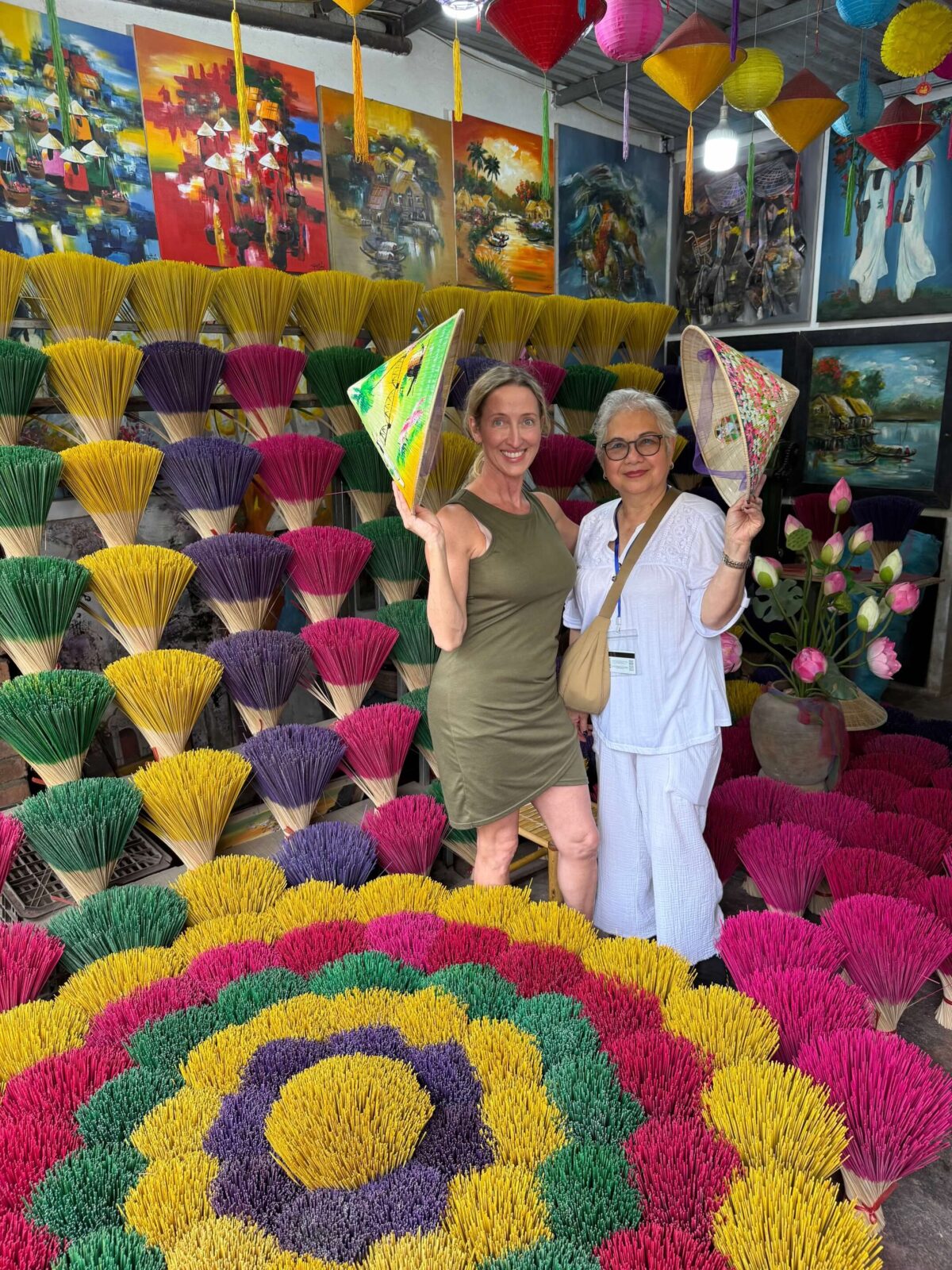
On a later trip to Vietnam, I returned to Hue on a cruise excursion and finally had time to explore some of the city itself. We wandered through the enormous Imperial City, visited a local market that felt wonderfully removed from the more polished tourist stops, and stopped at one of Hue’s colorful incense villages—a place that is admittedly set up for visitors but is also charming, ridiculously photogenic, and a lot of fun.
That second visit completely changed my impression of Hue.
Hue is quieter than Hanoi and less polished for tourism than Hoi An, but that’s part of what makes it interesting. This former imperial capital is packed with Vietnamese history, elaborate architecture, temples and tombs, fantastic food, and glimpses of everyday life that can feel surprisingly local once you get away from the major sights.
What made that visit even more special was exploring the former imperial capital with my mother-in-law, who is a descendant of the Nguyen Dynasty. It’s not every day you get to explore a place with someone whose family history is connected to the people who once ruled there.
And yes, the bún bò really is worth stopping for.
If you’re traveling through central Vietnam, don’t make my original mistake and treat Hue as somewhere you simply pass through. Give yourself enough time to actually explore it.
Hue at a Glance
Where is Hue? Hue is in central Vietnam, along the Perfume River, north of Da Nang and Hoi An and south of Phong Nha.
What is Hue known for? Hue was Vietnam’s imperial capital from 1802 until 1945, during the Nguyen Dynasty. Today, it’s best known for its enormous Imperial City, royal tombs, pagodas, the Perfume River, and a food culture that is reason enough to visit. The Complex of Hue Monuments has been a UNESCO World Heritage Site since 1993.
How do you pronounce Hue? You’ll hear English speakers say something close to “hway,” although the Vietnamese pronunciation is a little more nuanced. Don’t worry too much about perfecting it before you arrive.
How long should you stay? If you’re traveling through Vietnam on a tight schedule, one night in Hue is enough for an introduction to the Imperial City and some fantastic food. But I’d recommend two nights if you can spare them, especially if you want to visit the royal tombs, explore the markets, or get out into the countryside. Three nights would give you even more freedom to explore at a relaxed pace.
Best time to visit Hue: February through April generally offers some of Hue’s most pleasant sightseeing weather. Summers can be seriously hot, while the wetter part of the year brings a much greater chance of prolonged rain and even flooding. Hue’s weather doesn’t always behave like nearby Da Nang and Hoi An, so check the forecast for Hue specifically rather than assuming all of central Vietnam will be the same.
Nearest airport: Phu Bai International Airport (HUI) serves Hue. It’s roughly a 30-minute drive from central Hue.
Getting there without flying: Hue is on Vietnam’s main north-south railway line, so arriving by train is another option. If you’re coming from the south, traveling between Da Nang and Hue over the Hai Van Pass can turn the journey itself into part of the experience.
The overall vibe: Historic, atmospheric, food-focused, and noticeably more relaxed than Vietnam’s biggest cities. Hue isn’t a place I’d rush through. The history is obviously the headline, but some of my favorite memories here came from much simpler things—wandering through a local market and eating an incredible bowl of bún bò at a completely unassuming roadside restaurant.
Why Visit Hue
If Hanoi gives you energy, Hoi An gives you charm, and Phong Nha gives you adventure, Hue gives you history.
This was Vietnam’s imperial capital for nearly 150 years, and you don’t have to be a serious history buff to appreciate what remains. The Imperial City alone is reason enough to stop. It’s enormous, and walking through its gates, courtyards, temples, gardens, and surviving palaces gives you a much better sense of Vietnam’s imperial past than simply reading about it.
But I wouldn’t visit Hue only for the history.
Hue also feels different from some of Vietnam’s more heavily traveled destinations. Away from the major attractions, everyday life takes center stage. I particularly loved wandering through a local market, surrounded by unfamiliar ingredients, food stalls, and the wonderful chaos of people simply going about their day.
Then there’s the other side of Hue tourism. The colorful incense village we visited was absolutely photogenic and absolutely aware that people come there to take pictures. And you know what? I still loved it. Not every experience has to feel undiscovered to be enjoyable. Sometimes something can be touristy and charming.
And then there is the food.
Hue has one of Vietnam’s most distinctive regional cuisines, shaped in part by its history as the imperial capital. You can find elaborate dishes with royal roots alongside some wonderfully simple local food. Bún bò is the obvious example—and after stopping for a bowl on my first trip through Hue, I understand why this spicy, fragrant noodle soup has traveled so far beyond its hometown.
Hue also works beautifully as part of a longer trip through central Vietnam. Combine it with Phong Nha to the north and Da Nang and Hoi An to the south, and suddenly Hue isn’t a detour at all. It’s one of the pieces that makes the entire route more interesting.
*Jennifer’s Tip*: Don’t judge Hue by how it looks on a list of attractions. On paper, “citadel, tombs, pagodas” can sound like a destination primarily for history lovers. In person, it’s much more layered than that. Come for the Imperial City, but leave time to eat, wander, poke around a market, and see what you find.
Where to Stay in Hue
I haven’t actually stayed overnight in Hue. Both of my visits were short—one was essentially a very enthusiastic bún bò stop, and the other was a day trip from a cruise—so I can’t give you one of my usual firsthand hotel recommendations.
But if I were planning an overnight visit, I would stay centrally, near the Perfume River, where you can easily get to restaurants, cafés, the riverfront, and many of Hue’s main attractions.
For most first-time visitors, the area on the south side of the Perfume River is probably the easiest base. This is the more modern part of Hue, with plenty of hotels and restaurants and easy access across the river to the Imperial City. The area around the walking streets is livelier in the evenings, so stay a few blocks away if you’d rather have quiet than nightlife.
If you want something with more history and atmosphere, Azerai La Residence Hue would be high on my list. The hotel occupies a striking Art Deco building overlooking the Perfume River and is one of Hue’s best-known luxury properties.
For a central upscale option, Melia Vinpearl Hue is a modern high-rise in the heart of the city with fantastic views from the upper floors. If location and convenience are more important to you than historic character, this is the sort of place I’d consider.
Another interesting option is Pilgrimage Village Boutique Resort & Spa, which sits outside the center in a greener, quieter setting. You give up the ability to simply walk out the door and explore downtown, but it could be a great choice if you want your Hue stay to feel more like a retreat.
*Jennifer’s Tip*: For a first visit, I’d prioritize location over having a resort-style hotel. Hue is a city I would want to explore, eat my way through, and wander around rather than spend most of my time at the hotel. Stay somewhere comfortable and central, then get out and see the city.
The Best Things to Do in Hue
You could come to Hue, visit the Imperial City, take a few pictures and move on. But you’d be missing much of what makes the city interesting.
Hue’s history is obviously the main attraction, and you should absolutely spend some time exploring it. But this is also a great city for wandering through markets, eating your way through local specialties, riding a bicycle or scooter into the countryside, and getting a glimpse of life beyond the major monuments.
Explore the Imperial City
If you only visit one historical attraction in Hue, make it the Imperial City.
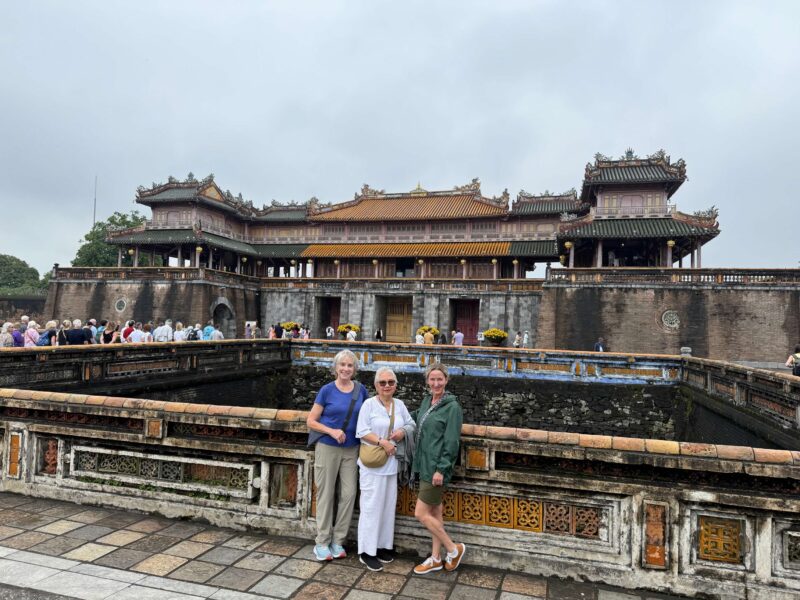
With Mom Do (Maiden name=Nguyen) and Sara in front of the Imperial City
This enormous walled complex was the political and ceremonial center of Vietnam’s Nguyen Dynasty. Inside are gates, courtyards, temples, gardens, residences, and the remains of the Forbidden Purple City, which was reserved for the emperor and royal family.
We visited as part of our cruise excursion, and this was easily the historical highlight of the day. It’s much bigger than I expected, so don’t plan on popping in for 30 minutes and calling it good.
I also think this is one place where having a guide adds real value. Without some historical context, you’re looking at a succession of beautiful old buildings. With a guide, you begin to understand what happened here, who lived here, and how the different parts of the complex were actually used.
If you’d rather have someone put the whole story together for you, Project Expedition offers a Hue City Tour: Exploring the Imperial Capital that combines the Imperial City with Thien Mu Pagoda, Dong Ba Market, royal tombs, and a Perfume River boat ride.
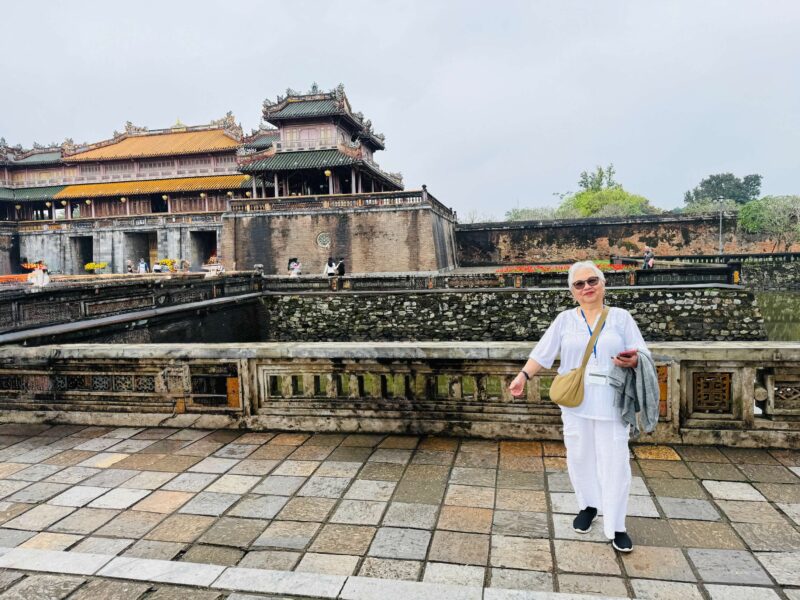
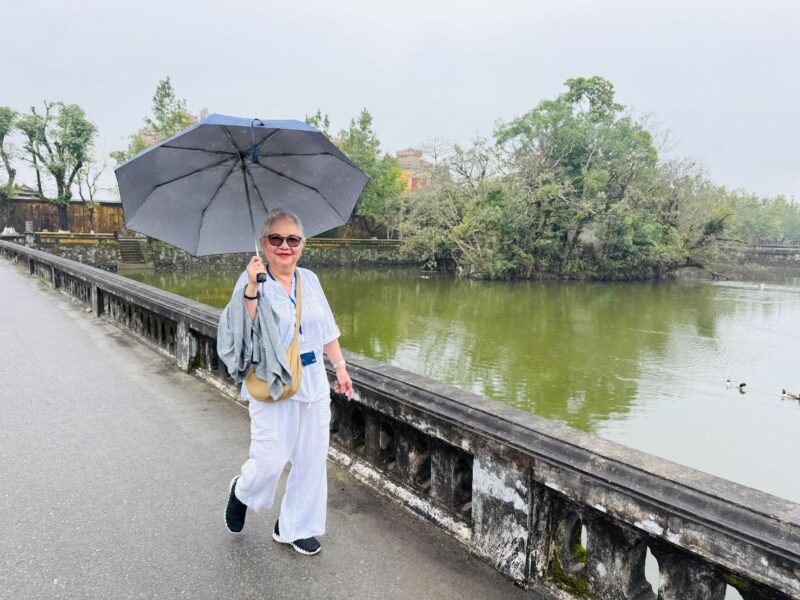
Mom Do at Hue’s Imperial City. As a descendant of the Nguyen Dynasty, she brought a pretty special family connection to our day exploring Vietnam’s former imperial capital.
Visit the Royal Tombs
Hue’s imperial history extends well beyond the walls of the Citadel.
The countryside surrounding Hue contains the elaborate tomb complexes of the Nguyen emperors. Among the most frequently visited are the tombs of Minh Mang, Tu Duc, and Khai Dinh, and they’re surprisingly different from one another.
If you’re interested in history and architecture, I’d choose at least one rather than trying to race through every tomb in a single day. Hue is a place where it would be very easy to give yourself historical-site fatigue.
See Thien Mu Pagoda
Sitting above the Perfume River, Thien Mu Pagoda is one of Hue’s most recognizable landmarks.
Its seven-story tower is one of those images you’ll see over and over again when researching Hue, but the setting along the river is part of the appeal. It’s easy to combine with the Imperial City, royal tombs, or a Perfume River boat ride.
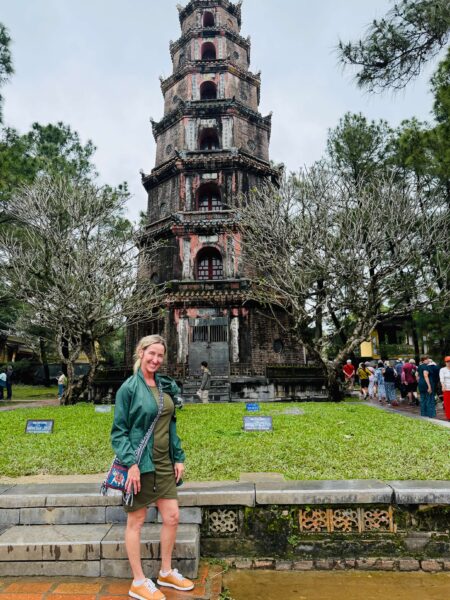
The seven-story Phuoc Duyen Tower at Thien Mu Pagoda, one of Hue’s most recognizable landmarks.
Wander Through a Local Market
You know I love a local market.
Our market stop was one of my favorite parts of our excursion because it gave us a completely different look at Hue after spending time among the city’s historical monuments. Mom Do especially enjoyed it as she chatted with the ladies selling their wares and they fawned over how beautiful she looked- she certainly seemed to feel like royalty today!
Markets are messy, colorful, sometimes overwhelming, and full of everyday life. I love wandering around without necessarily looking for anything—watching people shop, seeing unfamiliar ingredients, smelling whatever is cooking, and trying to figure out what everything is.
If you’d like to explore a local market yourself, Dong Ba Market is Hue’s largest and best-known market, with everything from produce, spices, and prepared foods to clothing and household goods.
And if you’re hungry, even better.
-
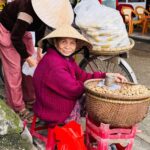
- Peanut Seller, Local Market, Hue
-
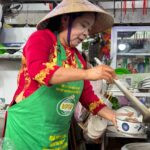
- Preparing Bun Bo (Hue) at a Local Market
-

- Mom Do Haggling Over Durian
Visit the Colorful Incense Village
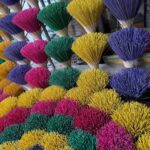
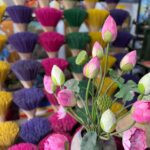
The famous bundles of brightly colored incense make Thuy Xuan Incense Village one of Hue’s most photogenic stops.
Let’s be clear: this isn’t some secret village where you’ll be the first traveler to discover people quietly making incense. Tourism is very much part of the experience.
I still enjoyed it.
The displays are beautiful, you can learn a little about traditional incense making, and it’s a fun place for photographs. Sometimes a place can be touristy and charming. The two aren’t mutually exclusive.

Take a Hue Food Tour
If I returned to Hue tomorrow, this would be near the top of my list.
Hue has such a distinctive food culture that a food tour makes a lot of sense here. Rather than ordering the one or two dishes you’ve already heard of, a local guide can introduce you to specialties you might otherwise walk straight past.
And this is a city where I definitely wouldn’t want to stop with bún bò.
Viator offers a Hue Food Tour by Walking, Cyclo, or Scooter, which I particularly like because you can choose how adventurous you’re feeling. The tour includes multiple local dishes and gives you a chance to experience Hue’s food with someone who actually knows what to order and where to find it.
Come hungry.
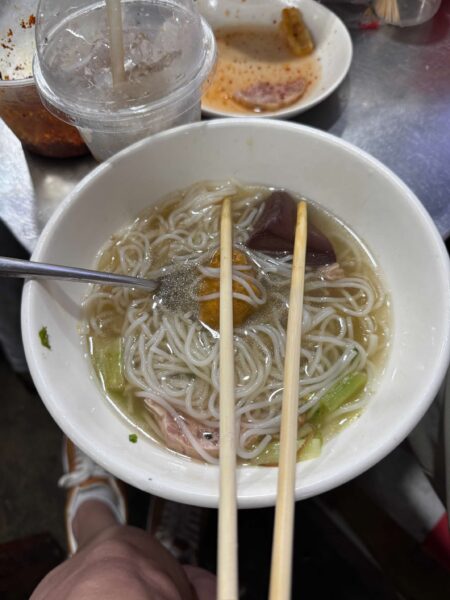
Bun Bo in the Local Market
Explore Hue on Two Wheels
Some of my favorite travel days have started with me saying, “I don’t know if we should rent a scooter.”
I’m almost always resistant to the idea. Traffic looks crazy, I start imagining all the things that could go wrong, and hiring a driver suddenly sounds much more sensible.
And then we rent the scooter.
And we have the best time.
There is something about having your own set of wheels that completely changes the way you experience a place. You’re not looking at Vietnam through a bus window or being driven directly from Attraction A to Attraction B. You can turn down a little road because it looks interesting, stop when you see something you want to photograph, pull over for food, or change your plans entirely because you spotted something you didn’t know existed.
Hue and the countryside surrounding it are particularly tempting places to explore this way.
If a scooter isn’t for you, get on a bicycle instead.
Hue has guided cycling tours that combine the city with quieter areas along the Perfume River and surrounding countryside. For a first visit, I like the idea of seeing some of the historical sights but getting there on two wheels instead of spending the entire day climbing on and off a tour bus.
For the kind of cycling experience I love, Viator offers a Hue Bike Tour with Optional Fishing Activities in a Local Village that gets you out of the city and into the surrounding countryside. You’ll ride along mostly flat country roads through villages, markets, rice fields, and farming areas—the kind of places where traveling by bicycle really lets you slow down and experience what’s around you.
You may not even need to arrange a separate bicycle rental. Some Hue hotels have bicycles available for guests or offer rentals, so it’s worth asking your hotel before making separate arrangements.
Or Let Someone Else Drive the Scooter
Want the scooter experience without actually driving one?
This might be my favorite compromise.
Several Hue tours put you on the back of a scooter with a local driver, which means you still get the wind-in-your-face, right-in-the-middle-of-everything experience without having to navigate Vietnamese traffic yourself.
Viator has a Hue City and Local Food Tour by Scooter that combines sightseeing with local food. You ride behind a local driver rather than driving yourself, making this a great option if you want the scooter experience but aren’t comfortable renting one.
Cruise the Perfume River
The Perfume River runs directly through Hue, and you’ll see the colorful dragon boats carrying visitors between some of the city’s major attractions.
I wouldn’t necessarily make a river cruise the centerpiece of my day, but it works nicely when combined with Thien Mu Pagoda or as a relaxing break between historical sites.
If you’ve been walking around the Imperial City in the heat for several hours, sitting down and letting someone else do the moving suddenly sounds pretty good.
What to Eat in Hue
You cannot come to Hue and not eat.
Well, technically you can. But you’d be doing it wrong.
Hue has one of the most distinctive regional cuisines in Vietnam, and its history as the former imperial capital had a huge influence on the food. The Nguyen emperors were served elaborate meals made up of numerous small, beautifully presented dishes, and that tradition of careful preparation and presentation still shows up in Hue’s cuisine today.
But don’t think you need to sit down for some elaborate royal banquet to eat well here. Some of the food I’m most interested in is exactly the opposite: inexpensive, intensely flavorful dishes served in markets, little restaurants, and roadside shops.
Bún Bò Huế
Let’s start with the obvious one.
My first visit to Hue was really more of a pass-through. We were traveling from Phong Nha to Da Nang, and our primary mission in Hue was to drop off our new friend Jerome, who had done the Son Doong trek with us and was continuing his travels from there.
Our secondary mission—arguably almost as important—was to eat bún bò Huế in Hue.
We stopped at a ramshackle little roadside restaurant that I couldn’t name now if my life depended on it (look at the photo… but good luck finding it). There was nothing fancy about the place, which honestly made it even better.
And that bowl of bún bò was incredible.
Bún bò Huế is a spicy beef noodle soup made with a deeply flavored broth, thick round rice noodles, beef, herbs, and typically lemongrass, chili, and shrimp paste. Depending on where you order it, you’ll find different cuts of beef and sometimes pork in the bowl as well.
Outside Hue, you’ll usually see it called bún bò Huế. In Hue, it’s generally just bún bò. You’re already in Hue. They know where you are.
I love phở, but bún bò is a completely different experience—spicier, richer, funkier, and more assertive.
If you eat only one thing in Hue, make it this.
Preferably somewhere that doesn’t look particularly fancy.
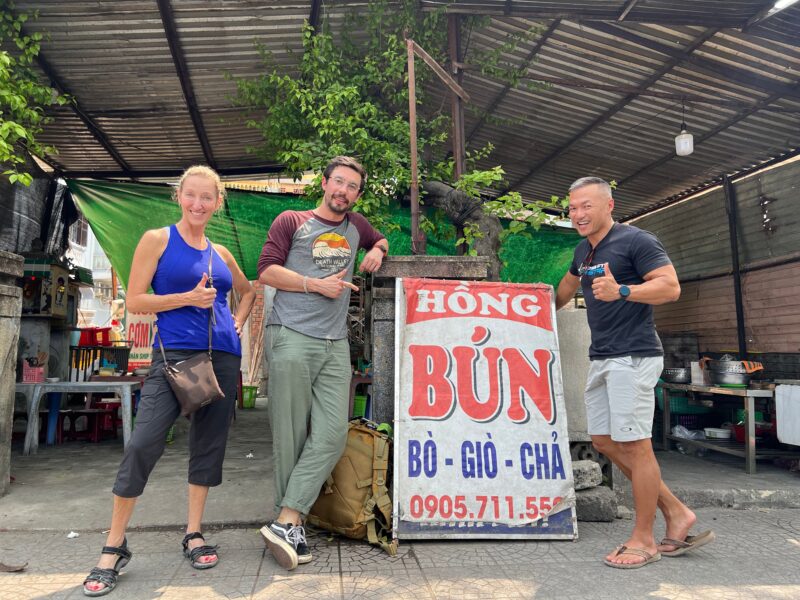
Bun Bo Hue with Jerome
Bánh Bèo
These tiny steamed rice cakes are one of Hue’s classic snacks.
They’re served in little individual dishes and topped with ingredients such as dried shrimp, scallion oil, and crispy bits, then eaten with fish sauce.
They’re small enough that eating one seems perfectly reasonable.
You will not eat one.
Bánh Khoái
At first glance, bánh khoái may remind you of bánh xèo, the crispy Vietnamese pancake you’ll find elsewhere in the country.
Hue’s version is generally smaller and thicker, with a crispy exterior and fillings such as shrimp, pork, and bean sprouts. What really sets it apart is the dipping sauce—a rich, savory sauce that can include peanuts, sesame, pork liver, and fermented ingredients. And that crunch is so satisfying!
This is exactly the sort of dish I’d want someone local to show me where to eat.
Nem Lụi
Nem lụi is grilled pork wrapped around lemongrass stalks or skewers and cooked over charcoal.
You typically wrap the pork with herbs and vegetables in rice paper and dip the whole thing into a rich sauce.
Grilled meat + fresh herbs + Vietnamese dipping sauce?
I’m in.
Bánh Nậm and Bánh Lọc
If you start seeing little banana-leaf packages everywhere, investigate.
Bánh nậm are soft, flat rice-flour cakes steamed in banana leaves, usually with shrimp and pork.
Bánh lọc are chewy, translucent tapioca dumplings generally filled with shrimp and pork. They can also be wrapped and steamed in banana leaves.
Both are classic Hue dishes and exactly the kind of thing that’s easy to overlook if you don’t know what you’re looking at.
Cơm Hến
This one is a little more adventurous.
Cơm hến is a Hue specialty made with rice and tiny basket clams, usually mixed with herbs, peanuts, crispy pork skin, chili, and other intensely flavored ingredients.
There’s also a noodle version called bún hến.
It’s spicy, salty, crunchy, fresh, and very Hue.
Try Hue’s Vegetarian Food
Hue also has a strong tradition of vegetarian cooking connected to the city’s Buddhist culture.
You’ll find vegetarian versions of Vietnamese dishes throughout the city, and even committed meat eaters shouldn’t automatically skip them. Vietnamese vegetarian food can be incredibly flavorful and creative.
Look for the word chay (or avoid it if you are a devoted carnivore), which indicates vegetarian food.
Eat Something You Can’t Identify at the Market
This may not be the most useful culinary instruction I’ve ever given you, but it’s one of my favorite ways to eat in Vietnam.
Walk through a market. Find the stalls where local people are eating. Look at what everyone else has.
Point.
I’ve eaten some wonderful things this way.
Have I always known exactly what they were?
Absolutely not.
*Jennifer’s Tip*: Don’t limit yourself to restaurants with English menus and hundreds of online reviews. Some of the best food we’ve eaten in Vietnam has come from little places we never could have researched ahead of time. If somewhere is busy with locals, take a look at what they’re eating and be curious. Worst case, you order something you don’t love. Best case, you end up thinking about a bowl of noodles from a ramshackle roadside restaurant years later.
How to Get Around Hue
Hue is fairly easy to get around, and you definitely don’t need to rent a car.
For most travelers, I think the best strategy is a combination of walking, Grab, and two wheels.
Hail a Grab
Good news: Grab works in Hue.
You can use the same Grab app you use elsewhere in Vietnam to order a car or a motorbike taxi. Grab is particularly convenient because you enter your destination into the app and see the price before you book—no trying to explain where you’re going or negotiating a fare.
If you’re traveling alone and don’t mind being on the back of a motorbike, GrabBike is an inexpensive and very Vietnamese way to get around. If there are two or more of you, it’s raining, or you simply want air-conditioning, order a GrabCar.
Hue even has GrabCyclo, which lets you book one of the city’s traditional three-wheeled cyclos through the Grab app. You can arrange a sightseeing ride around the Imperial City and central Hue without having to negotiate directly with a driver. Each cyclo carries one passenger, making this more of a fun sightseeing experience than practical transportation for getting around the city. You can snap photos of your traveling companion and vice versa!
Walk When You Can
Central Hue is quite manageable on foot, particularly around the riverfront, Dong Ba Market, and some of the central sightseeing areas.
The problem is that Hue’s attractions aren’t all clustered together. The royal tombs, in particular, are scattered several miles outside the center, so you’ll eventually need something besides your feet.
Rent a Bicycle
Hue’s relatively flat center and riverside roads make cycling an appealing way to explore. A bicycle gives you the freedom to wander through neighborhoods, stop at markets, and venture into the surrounding countryside.
Some hotels offer bicycles for guests or arrange rentals, so ask before booking separately.
Rent a Scooter
And then there’s the scooter.
Just don’t rent one simply because it’s cheap and looks fun. Vietnamese traffic operates very differently from traffic at home, so make sure you’re comfortable riding and meet the licensing requirements. A helmet is non-negotiable.
If you’d rather leave the driving to someone else, book a GrabBike or join a guided scooter tour. You’ll still get the open-air experience without having to navigate Vietnamese traffic yourself.
Hire a Driver for the Royal Tombs
If bikes and scooters aren’t your thing, hiring a driver for a half or full day is probably the easiest way to visit several of Hue’s royal tombs.
The tombs are scattered outside the center rather than sitting next to one another, so having a driver wait while you explore can be much more convenient than arranging transportation separately after every stop.
This is also one situation where a guided tour makes sense, especially if you want someone to explain what you’re looking at rather than simply provide transportation.
Take a Boat on the Perfume River
And because this is Hue, transportation doesn’t necessarily have to involve a road.
Dragon boats travel along the Perfume River and can be combined with visits to places such as Thien Mu Pagoda. I think of this more as sightseeing that happens to get you somewhere rather than the most efficient way to travel—but that’s part of the fun.
*Jennifer’s Tip*: Download Grab before your trip and then mix things up once you’re in Hue. Walk when you’re nearby, use Grab when you want to get somewhere efficiently, and consider renting a bicycle or scooter for a day when you want the freedom to explore. You don’t have to use the same type of transportation for your entire visit.
How Many Days Do You Need in Hue?
You can see some of Hue’s highlights in one busy day. That’s essentially what we did on our cruise excursion, visiting the Imperial City, a local market, and the incense village.
If you’re traveling through Vietnam with limited time, one night in Hue is enough for a good introduction. You can explore the Imperial City, enjoy some fantastic local food, and get a feel for the city before continuing your journey.
But if your schedule allows, I’d recommend two nights. That gives you time to visit a royal tomb or Thien Mu Pagoda, wander through the markets, and enjoy Hue without rushing from one attraction to the next.
If you’re especially interested in history, cycling, or exploring the countryside, you could easily stay longer. There’s plenty to discover beyond the city’s famous historical sites.
Jennifer’s Tip: Don’t add an extra night just so you can squeeze in five more attractions. Add it so you don’t have to rush. Sleep a little later. Have another bowl of bún bò. Get on a bike. Turn down a road you weren’t planning to take. That’s what the extra time is for.
Best Day Trips and Where to Go Next
Day Trips: Get Off the Usual Tourist Route
If you’ve already seen the Imperial City and royal tombs—or you simply need a break from historical monuments—there’s another side of Hue worth exploring.
This is where I’d rent a bicycle or scooter, head out of the city, and see what Hue looks like beyond the usual tourist stops.
Watch the Sunset at Tam Giang Lagoon
About 30–45 minutes outside Hue, Tam Giang Lagoon is part of a huge coastal lagoon system filled with fishing villages, aquaculture farms, small boats, and wetlands.
This is exactly the sort of place I love finding when we travel.
There’s not necessarily one big attraction you’re supposed to see. The experience is the landscape and the people who live and work around it. Go later in the afternoon, explore the fishing communities, eat some local seafood, and stay for sunset over the water.
If you’ve spent the morning surrounded by tour groups at the Imperial City, this would make a wonderful change of pace.
Explore Hue’s Countryside by Bicycle or Scooter
If you liked my earlier suggestion of exploring Hue on two wheels, the surrounding countryside is where I’d head next.
One particularly appealing destination is Thanh Toan Village, surrounded by rice fields and known for its beautiful tile-roofed Thanh Toan Bridge. But honestly, the reason I’d go is the ride itself.
Cycling through the countryside gives you a chance to see a different side of Vietnam. You’ll pass through small villages, past farms and gardens, roadside shops, and people simply going about their daily lives. It’s exactly the kind of experience we love when we travel.
If you’re comfortable and legally able to ride, a scooter lets you cover more ground and venture farther into the countryside. You don’t necessarily need a specific destination. Follow the smaller roads, stop for coffee or food when something looks interesting, and take a detour simply because you’re curious about where it leads.
And if you’d prefer not to navigate on your own, consider a guided bicycle or scooter tour. You’ll still get to experience rural Hue without worrying about finding your way.
*Jennifer’s Tip*: Take photos of signs identifying the towns and villages you pass through. They’ll help you remember where you’ve been, organize your photos, and look up those interesting little places when you get home.
Visit a Lesser-Known Royal Tomb
You don’t have to completely abandon Hue’s imperial history to get away from the busiest sightseeing route.
Most visitors concentrate on Khai Dinh, Minh Mang, and Tu Duc, but the Nguyen Dynasty left several other royal tomb complexes around Hue.
If you have an extra day and genuinely enjoy history, ask a local guide or driver about visiting one of the less frequently toured tombs. You may trade some of the grandeur of the famous sites for a much quieter experience.
Head to the Coast
Hue isn’t generally marketed as a beach destination, which may be exactly why it’s worth considering.
The coast east of the city has long stretches of sand and fishing communities that receive far less international attention than the beaches around Da Nang.
I wouldn’t sacrifice a day in Hue specifically to lie on a beach, but if you’re staying several days, renting a scooter and heading toward the coast could make for a wonderfully unstructured afternoon.
Where to Go Next From Hue
Hue sits in a fantastic spot for building a longer trip through central Vietnam. Whether you’re traveling north or south, you have some very good options.
Head South to Da Nang
If you’re traveling south, Da Nang is the natural next stop—but don’t automatically choose the fastest way to get there.
Take the Hai Van Pass.
The road winds through the mountains between Hue and Da Nang, with views of the coastline, mountains, beaches, and lagoons along the way. On a clear day, the scenery is spectacular.
You can travel the pass by private car, motorcycle, scooter, or one of the guided tours that turn the transfer itself into a sightseeing day. We actually saw a few crazy people biking it…
This is one of those times when getting from Point A to Point B doesn’t have to be wasted travel time. Make the journey part of the trip.
And don’t treat Da Nang as simply the airport you use to reach Hoi An. It’s a really cool city with excellent food, beaches, interesting neighborhoods, and plenty to explore on its own.
Continue to Hoi An
From Da Nang, continue south to Hoi An.
Yes, Hoi An is touristy.
It’s also beautiful.
The lantern-filled Ancient Town is famous for a reason, but Hoi An is much better when you give it more than a quick afternoon. Stay overnight, wander after some of the day-trippers have gone, eat everything you can, and get outside the historic center into the surrounding countryside.
Da Nang and Hoi An are close enough to explore on the same trip, but they offer very different experiences. Da Nang is a lively modern city with great beaches and food, while Hoi An is all about its historic streets, lanterns, and surrounding countryside. If you’re short on time, I’d stay in Hoi An and visit Da Nang along the way. But if you have a few extra days, Da Nang deserves time of its own.
Or Head North to Phong Nha
If you’re traveling north, Phong Nha would be my next stop.
This is where central Vietnam suddenly changes from imperial cities and historical monuments to caves, jungle, rivers, bicycles, and adventure.
You don’t have to trek into Son Doong to enjoy Phong Nha. There are spectacular caves that are much easier to reach, along with kayaking, biking, easy walks, and plenty of opportunities to simply explore.
Of course, if you are adventurous enough to do Son Doong, train for it and GO.
We actually traveled this route in the opposite direction, coming from Phong Nha through Hue on our way to Da Nang. Hue was where we dropped off our friend Jerome—and where we accomplished our other very important mission of finding a bowl of bún bò.
My Favorite Central Vietnam Route
If you’re trying to put all of this together, I’d make Hue part of a larger journey rather than treating it as an isolated destination:
Phong Nha → Hue → Hai Van Pass → Da Nang → Hoi An
Every stop gives you something completely different: caves and adventure in Phong Nha, imperial history and incredible food in Hue, mountain and coastal scenery along the Hai Van Pass, modern Vietnamese city life in Da Nang, and the lantern-filled streets and countryside of Hoi An.
*Jennifer’s Tip*: Before you book another flight, look at the map. Central Vietnam is one of those places where traveling overland can be part of the experience. Sometimes the road between two destinations is every bit as memorable as where you’re going next.
What I’d Tell a Friend Going to Hue
Don’t skip Hue.
And don’t make my original mistake of thinking that passing through town for an incredible bowl of bún bò means you’ve actually been to Hue.
I’ve now been to Hue twice, but I still feel like I’ve only scratched the surface. One visit was essentially a noodle stop on our way to Da Nang, and the other was a cruise excursion where someone else had planned our day for us. I loved what I saw, but next time I’d like to do Hue differently.
I’d stay a little longer. I’d get on two wheels. I’d eat more. I’d wander more. And I’d leave enough empty space in the itinerary to see what we find.
Because the Imperial City may be what brings you to Hue, but I have a feeling the things you never planned to see might be what you remember most.



0 Comments